.png)

Why AEO is the most profitable shift your marketing team can make in 2026
Your marketing team is bragging about a dying metric
Stop looking at your Google Search Console. It is lying to you.
I see marketing teams obsessed with their wonderful SEO strategy. They show you charts of high organic traffic and climbing keyword rankings. They celebrate because they are on page one for a thousand different terms. But when you look at the revenue, the story changes. The pipeline is flat. The leads are low quality. The sales team is frustrated.
It is stupid.
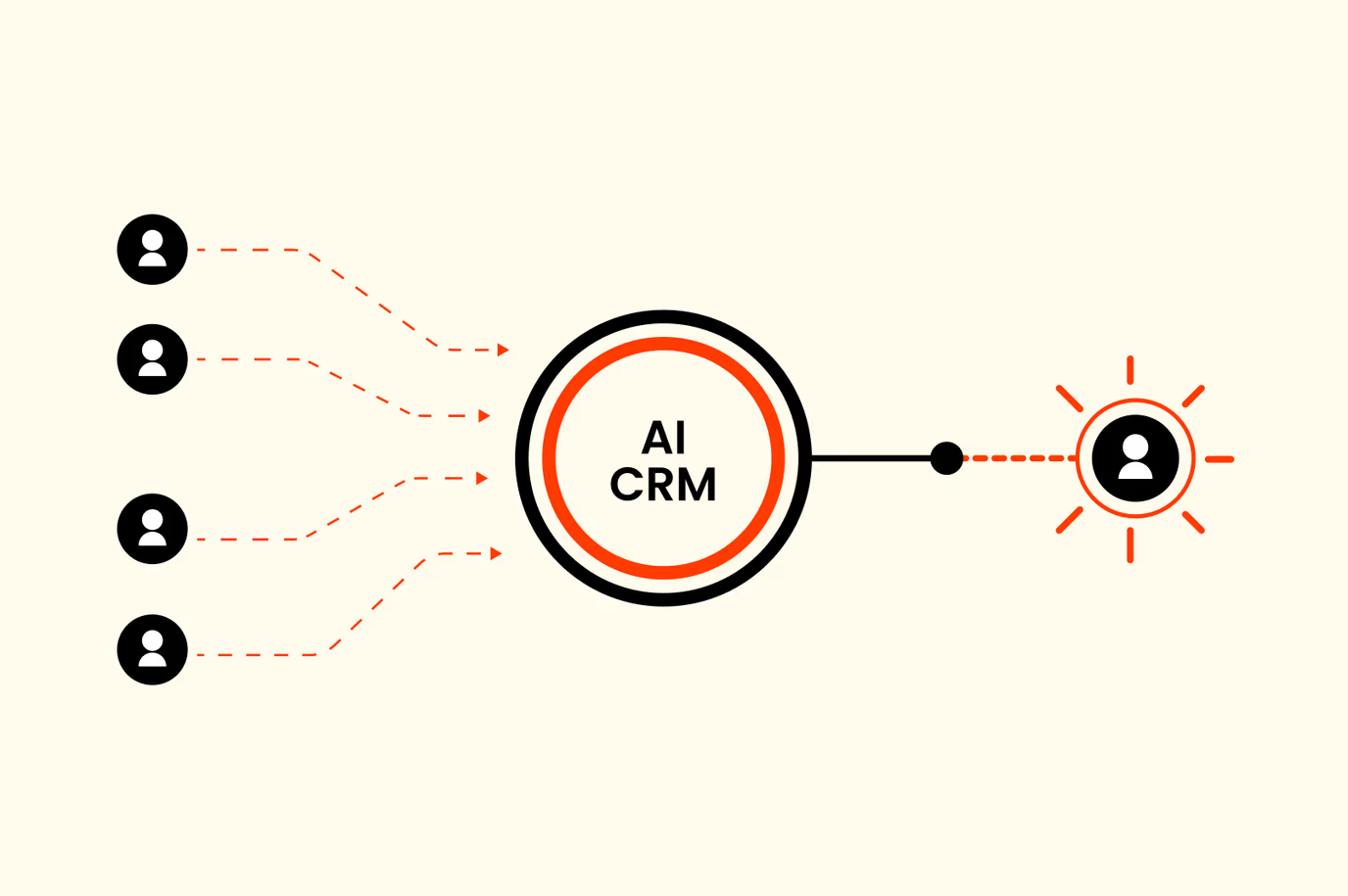
The reality in 2026 is that 73% of people now get exactly what they need without ever clicking a single link. Your potential buyers are not visiting your website because the AI gave them the verdict before they even finished typing their question. If your team is still bragging about traffic in a zero-click world, they are effectively celebrating a house that is on fire. The zero-click shift is not a theory — it is the dominant pattern in AI search today.
The term is Answer Engine Optimization, or AEO. For a CEO, the explanation is simpler: you are becoming invisible. If you are not the primary source the AI quotes when a buyer asks for a recommendation, you are not even in the deal.
I have spent the last twelve months studying this shift. Here is what being the only answer that matters actually requires.
Why your massive guides are actually hiding your brand
For a decade, the B2B rule was simple: publish more, rank higher, get more clicks. The old skyscraper strategy told us that if a competitor wrote a thousand words, we should write three thousand.
In 2026, that strategy is a suicide mission.
AI models like Perplexity and SearchGPT are junkies for information density. They do not want your massive guide. They certainly do not want to dig through a long introduction about the history of your industry just to find one specific answer.
When you write for old search engines, you use filler to satisfy an algorithm. When you write for 2026's answer engines, you use authority. AEO is about precision; traditional SEO was about volume. Every fluff sentence you include is a signal to the AI that your content is low-value. The AI will simply bypass your long-form essay and quote a competitor who gave the direct answer in forty words.
If your marketing team is still bragging about word count and traffic volume, they are actively burying your brand.
AI content is a mirror — you need to be the source
There is a paradox in 2026. The more AI content your competitors pump out, the more valuable your actual human expertise becomes.
Most founders think AI can write their entire strategy. It cannot. AI is a mirror. It can only remix what has already been said. If your website only says what the AI already knows, why would an AI ever cite you? You are not a source. You are an echo.
Our process at dotfun is built on a human-first approach. Here is how we take a raw idea and turn it into an AI-preferred answer:
- Identify the insight gap. We do not start with keyword tools. We start with a human expert. What is a truth in your industry that everyone else is ignoring? That new information is the only thing the bots are hungry for.
- Semantic mapping. We use AI to map out the answer graph. We ensure your content is not just an article but a structured knowledge base that an AI can pull from to answer fifty different related questions.
- The expert narrative. This is the non-negotiable part. A human writes the core message. Why? Because an LLM or AI model cannot give you a hot take. It cannot share a story about a failed project that led to a breakthrough. That lived experience is what earns the citation.
- AI content optimization. Finally we use AI to translate that expertise into the specific format the bots love by cleaning up the digital handshake.
The LLMs.txt debate: what you actually need to know
If you have been in any SEO conversation this year, you have heard about LLMs.txt — a proposed standard file you place in your site's root directory to tell AI models where your most important content lives. Think of it as a curated table of contents built specifically for AI crawlers.
Here is where it gets interesting: Google's John Mueller compared LLMs.txt to the old meta keywords tag — implying it is unnecessary — and no major AI platform has formally adopted the standard. Search Engine Journal reports that even SEO tools flagging its absence as an error are creating confusion, not reflecting reality.
But here is the counterargument, and it is a reasonable one: robots.txt, sitemaps, and schema.org all started as proposals that nobody used. Search Engine Land argues that LLMs.txt is fundamentally different from meta keywords because it points to real, verifiable content — not self-declared relevance. Perplexity already references structured summaries, and smaller AI tools are testing ingestion layers.
Our take? The cost of adding an LLMs.txt file is close to zero. The downside of not having one, if adoption picks up, is real. This is a low-risk, low-cost insurance policy. Do not bet your strategy on it. But do not ignore it either. Add it, point it to your best content, and move on to the things that actually move the needle.
Proprietary data and unique perspective are the only tools you need
I see leaders spending thousands a month on AI SEO suites and various GPT wrappers. Most of these tools are just trying to trick a version of the internet that died last year. They offer scores and optimization grades that mean nothing in a world of generative answers.
You do not need a dashboard score to tell you whether your content earns citations. You need to provide better and faster answers than anyone else.
It comes down to two things:
- Technical health. Can the bots find and read your data? This means proper Schema.org implementation and an LLM.txt file.
- Original voice. Do you actually have something to say that has not been said a million times before?
If you have those two things, you do not need a tool to optimize your content. The AI will find you because you are the most useful source.
Your leads are stalling because of attribution dark matter
We are entering an era of attribution dark matter. Your buyers are making decisions inside AI interfaces long before they ever land on your pricing page.
The brands that survive will be the ones that stop treating their website as a destination and start treating it as a knowledge base. If your current marketing team is bragging about ranking number one but your inbound pipeline is stalling, you are likely a victim of the zero-click shift. You are winning a game that nobody is playing anymore.
How to audit your top three revenue pages in thirty minutes
The era of ranking is over. The era of being the answer is here. If you want to protect your market share today, do not audit your keywords. Audit your answers.
- The forty word rule. Go to your top-performing page. Does the first paragraph answer the main question in under forty words? If there is any fluff about what the blog post will explore then delete it. The AI ignores it and so do your buyers.
- The Schema.org check. Are you using FAQPage and CitableItem schema? Without these you are leaving it up to chance whether the AI gives you credit for your knowledge.
- The LLM.txt install. If you do not have this in your root directory today you are telling the AI models they are not invited to your site.
The difference between AEO and GEO
I get asked this constantly by decision-makers. Is answer engine optimization and generative engine optimization the same thing?
The answer is no, and the distinction matters for your budget.\
- AEO is about the result. It is about winning the direct and single answer to a specific question.
- GEO is about the narrative. It is about influencing how an AI describes your entire category or compares you to a competitor.
You need a strategy for both. AEO gets you the featured snippet and the AI citation when someone asks a specific question. GEO gets you the recommendation when a buyer asks what the best tool for their specific problem is.
The final word on your 2026 strategy
Stop optimizing for search engines. Start optimizing for answers. This guide was built using the same process we use for clients. Not by a bot.
The click is dying, but the answer is more valuable than ever. If you want to go deeper on how AEO fits into a full B2B growth marketing sequence, start there. If you want to see how your brand looks through the eyes of an AI, let's talk.
Frequently Asked Questions
What is AEO and why does it matter more than SEO right now?
AEO is the practice of making your brand the primary answer that AI models surface to users. Traditional SEO was about appearing in a list of blue links. AEO is about being the source the AI synthesizes. It matters more because buyers are getting answers from ChatGPT, Perplexity, and Gemini without ever clicking a search result. If you are not the answer, you are not in the deal.
Is AEO and generative engine optimization the same thing?
No. AEO is about the result — winning the single, direct answer to a specific question. Generative engine optimization (GEO) is about the narrative — influencing how an AI describes your category or compares you to a competitor. You need AEO for the "what is" and "how to" queries, and GEO for the "who is the best" conversations.
What are the best practices for AEO in 2026?
Information density is the most important practice. Stop writing for word count and start writing for answer density. Use the forty-word rule: every header should be followed by a direct answer in under forty words. Combine that with proper Schema markup and clean site architecture to make it easy for AI models to find and cite your content.
What are the best tools for answer engine optimization?
Stop looking for a magic software button. Most "AEO tools" are legacy SEO tools with a new label. Use tools like Gemini or GPT to help structure your thoughts, but provide the perspective yourself. The best tool for AEO is proprietary data and a unique point of view that has not been scraped into a database yet.
How do I check my AEO visibility?
Do not look at rankings. Look at citations. Ask Perplexity, SearchGPT, or Gemini a question about your industry and see who gets quoted. If it is quoting your competitor using your data, your technical setup needs work. If it is not mentioning you at all, your content lacks original insight. The AI's response is your real scoreboard in 2026.
How does AEO fit with traditional SEO?
AEO does not replace SEO — it extends it. Strong technical SEO (site speed, crawlability, structured data) is still the foundation. AEO adds a layer on top: making your content the most citable, direct, and authoritative answer for the queries that matter to your business. Teams with excellent SEO fundamentals are best positioned to win in answer engines too.