
Iris features: one AI
Most businesses assemble their front office out of parts.
A phone service, a chat widget, a booking link, a texting app, an empty CRM. Each part holds a piece of the customer, and the customer feels every gap. Iris works the other way around: one system running one motion. The conversation gets answered wherever it starts, the lead gets qualified, the appointment gets booked, the follow-up goes out, and the record writes itself.
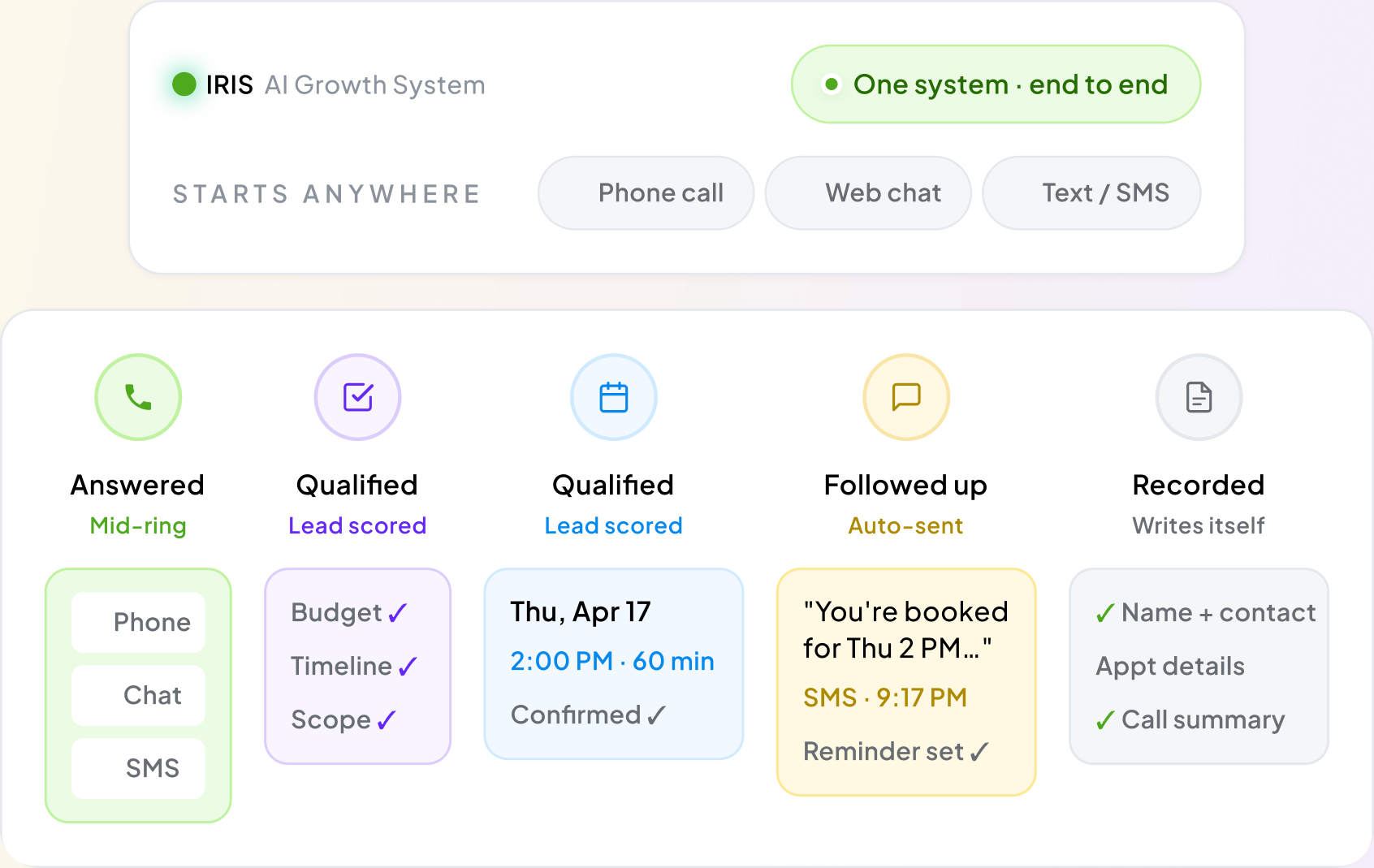
What happens between the first
A homeowner calls at 7:40 on a Tuesday evening, after your office closed. Nobody retyped anything. Nobody checked availability in another tab. The motion does not change when the lead arrives another way: a visitor at midnight, a text on Saturday morning, a call during the lunch rush.
Same sequence, same record waiting at the end.
Capture
Iris answers in your voice: call, chat, or text, any hour.
Qualify
Asks what broke and works out whether this is an emergency or a Thursday appointment.
Book
Offers two times that are actually open and takes one while they are still on the line.
Follow up
The confirmation text goes out, and the reminder follows before the slot.
Record
The whole exchange is filed as a qualified record in the CRM, thread attached.
Seven Iris features, and the page behind each
Each card is the short version.
The linked page carries the depth: the awkward cases, the setup, and where a human should still step in.
AI Receptionist
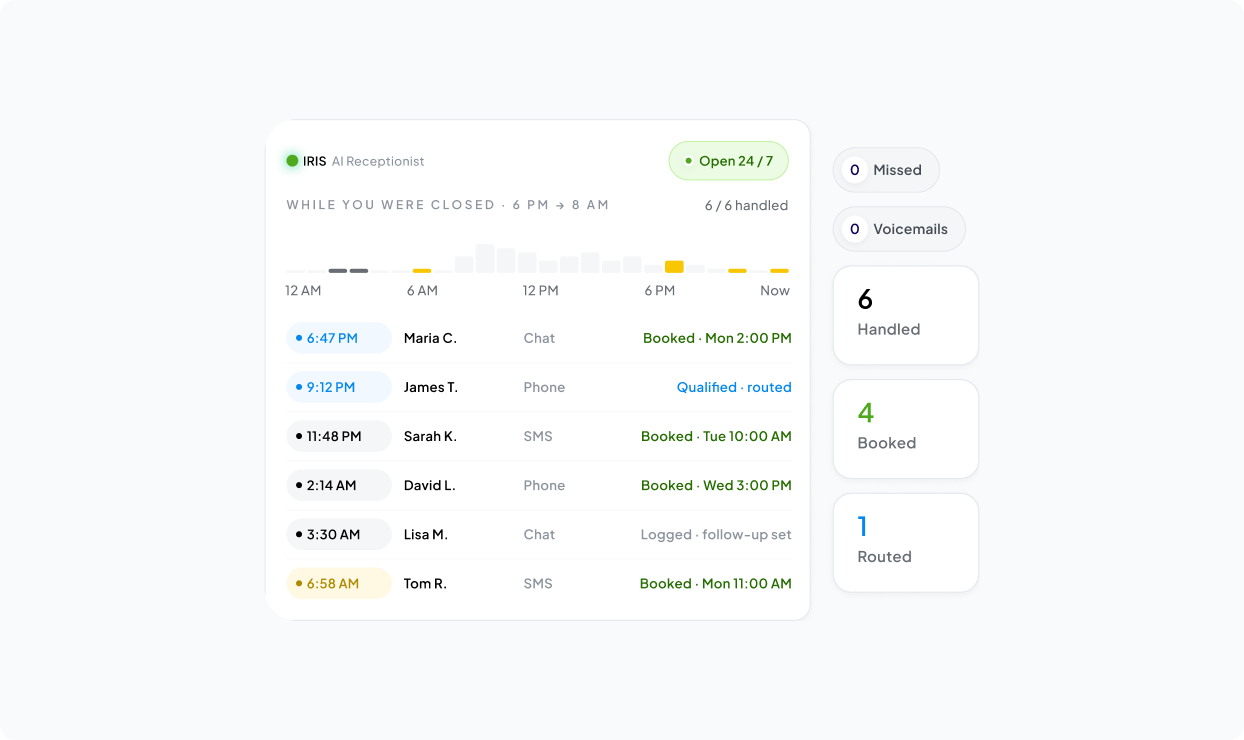
The call gets answered, every time, by something that can hold a real conversation: your greeting, the caller's need worked out, the serious inquiry separated from the vendor pitch, and a time booked or the right person notified.
Explore the AI ReceptionistAI Voice
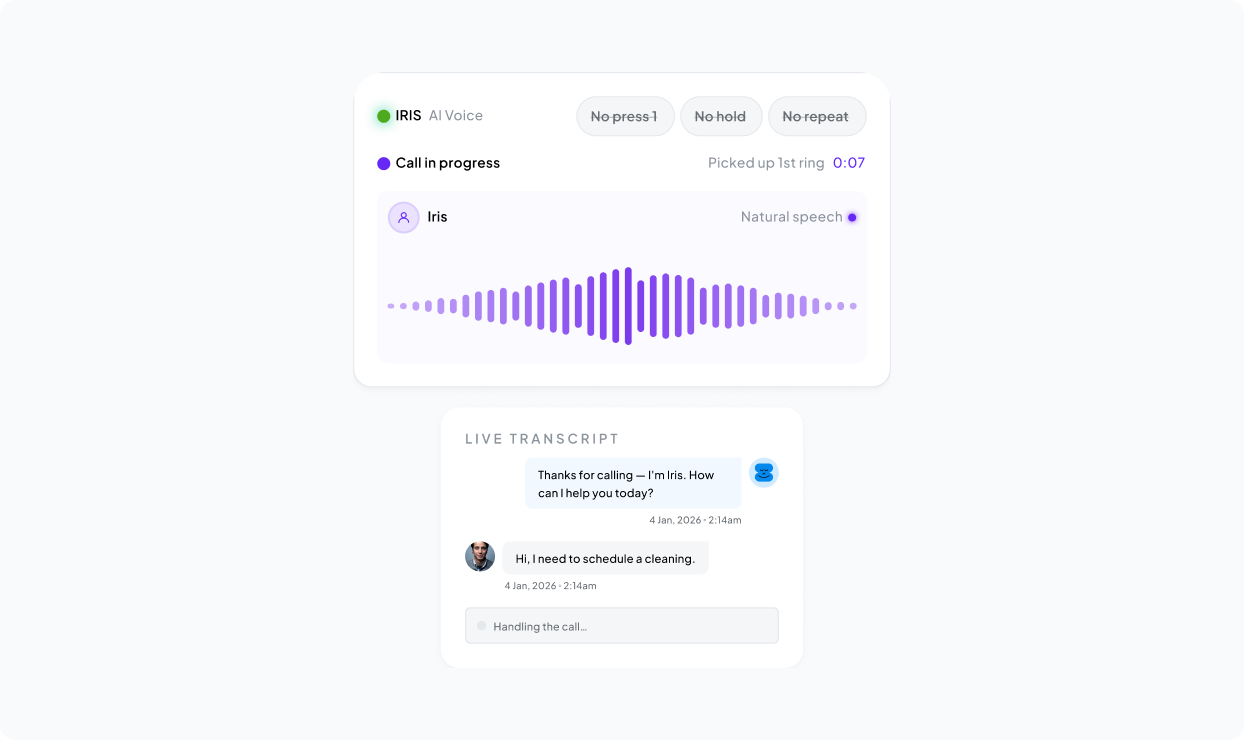
Phone conversation that does not sound like a menu. Callers interrupt, change their minds, and trail off halfway through a sentence, and Iris follows all of it in plain speech. No keypad options, no hold music.
Explore AI VoiceAI Web Chat
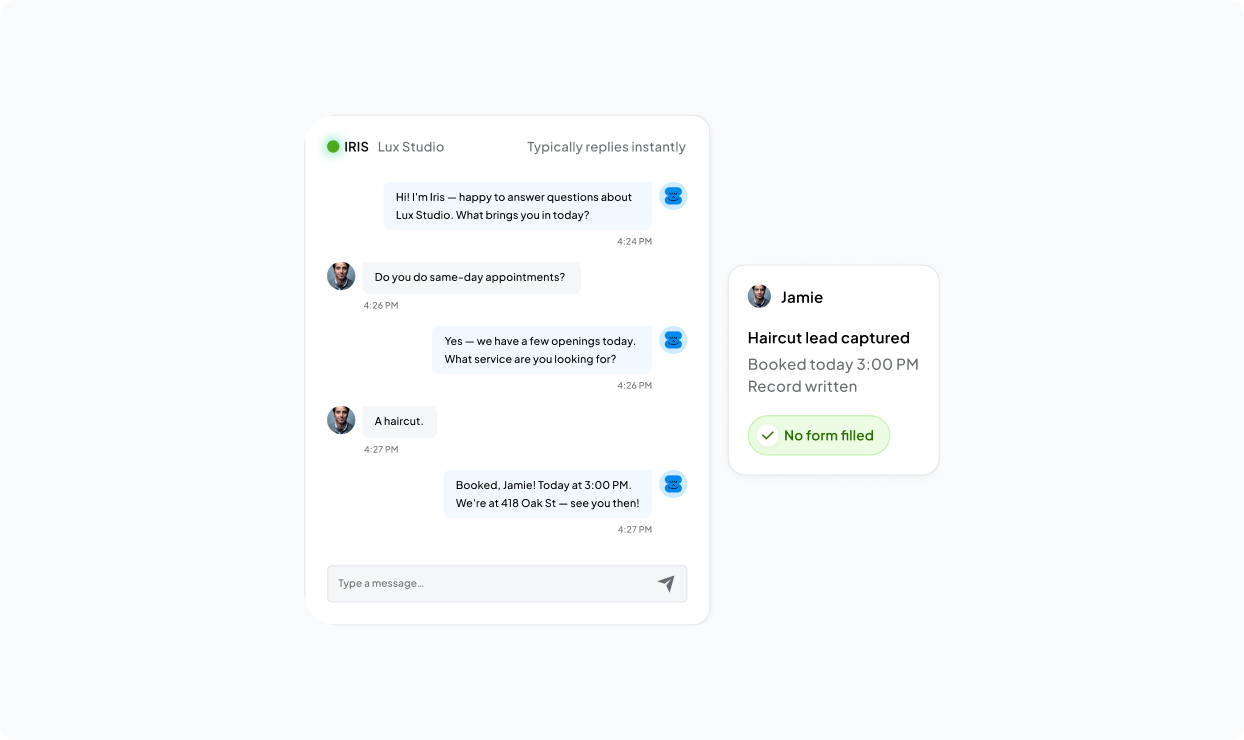
Your website gets visitors at midnight who will never fill in a form. Iris talks to them, answers using your own information, and turns an anonymous session into a named person with a stated need.
Explore AI Web ChatAI SMS
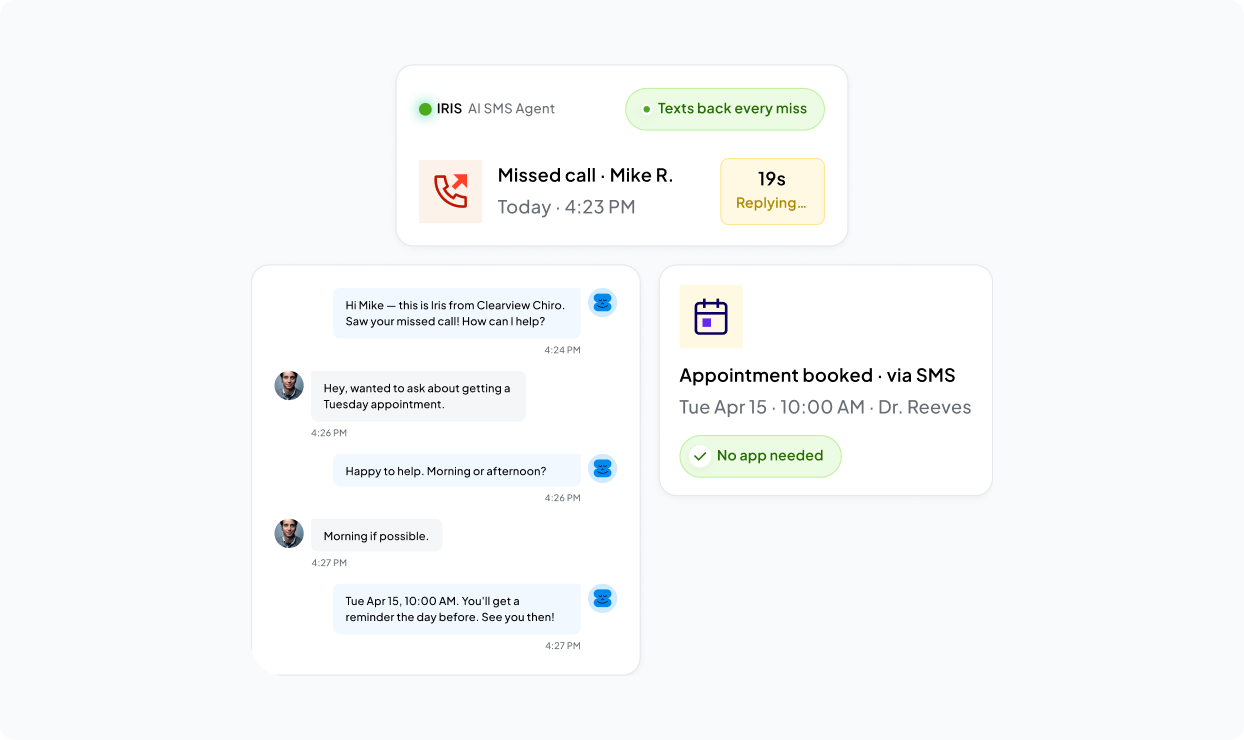
Text is where the thread stays alive. A call that slips through gets a text back within moments, a finished conversation gets the follow-up nobody had time to send, and a booked appointment gets the reminder that keeps it.
Explore AI SMSAI Calendar
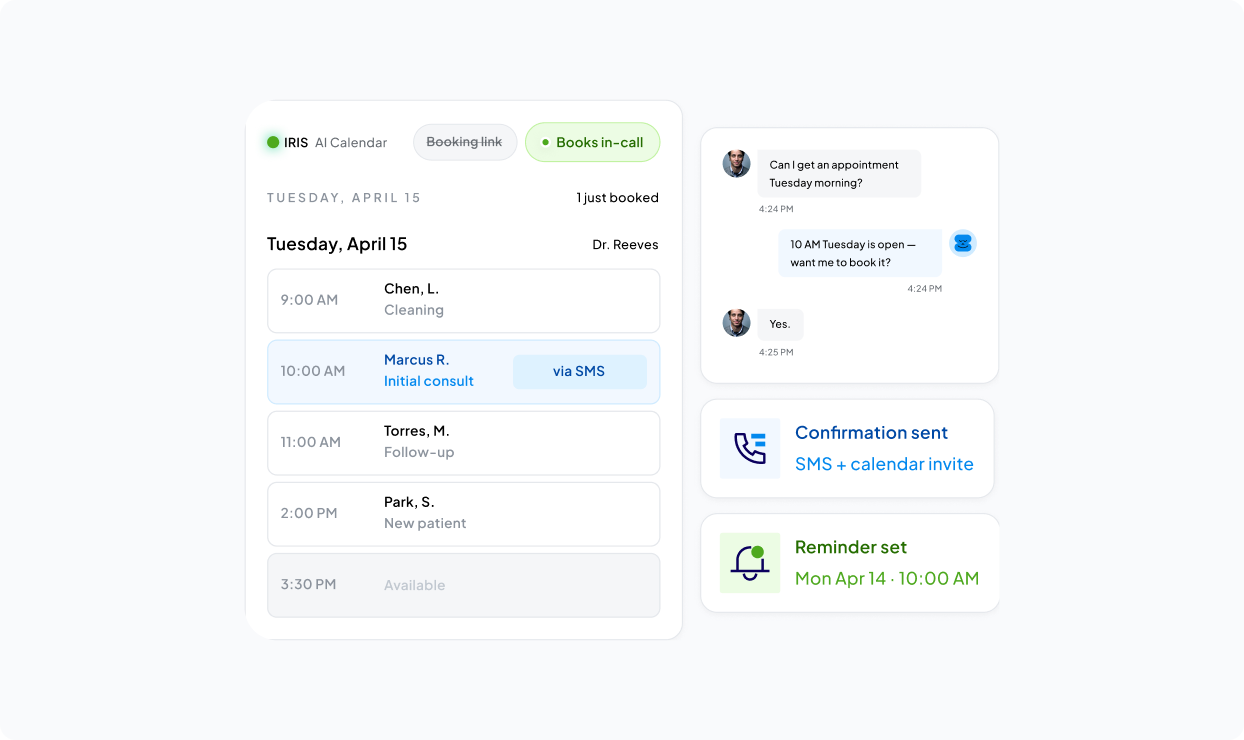
Booking happens inside the conversation, not in a link sent afterwards. Iris reads your real availability, takes the slot while the person is still on the line, then handles the confirmation, the reminder, and the inevitable change of plan.
Explore the AI CalendarAI CRM
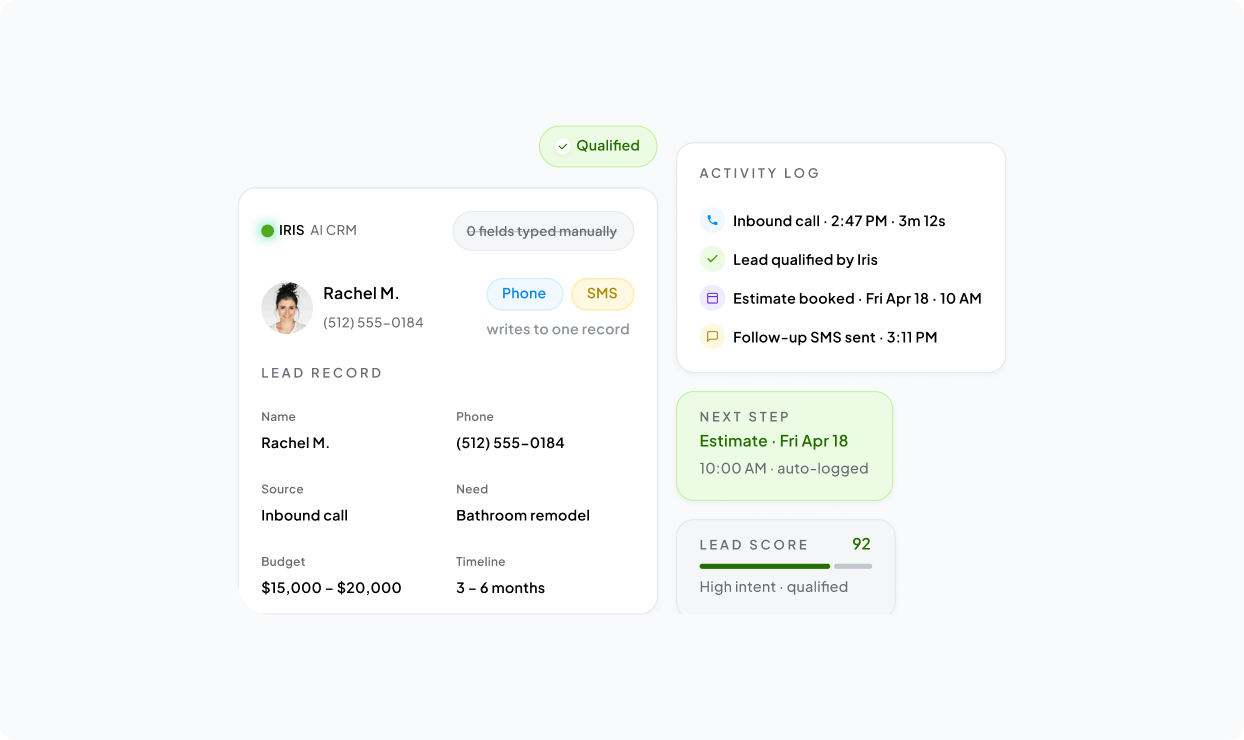
Every conversation writes itself down. Calls, chats, and texts arrive as structured, qualified records with the full thread attached, so nobody reconstructs the week from memory on Friday afternoon.
Explore the AI CRMContext Engine
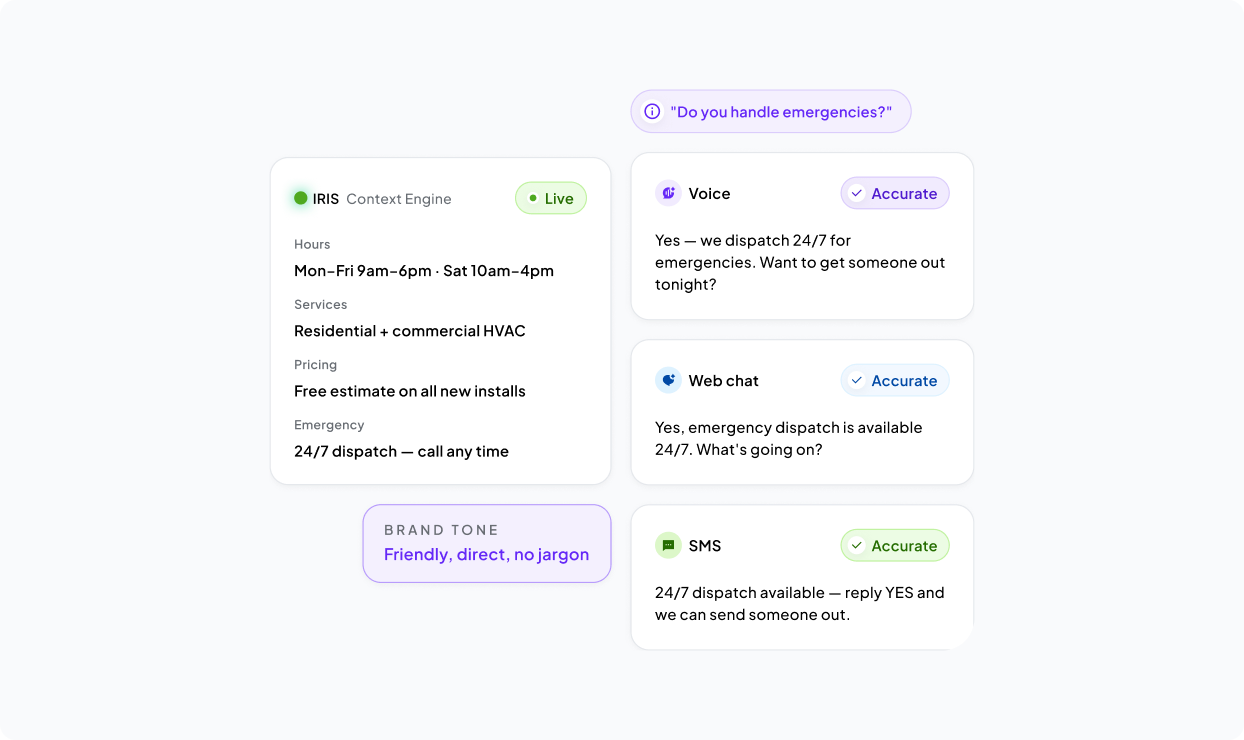
The reason the other six agree with each other. It holds what your business actually is, and every feature consults it before speaking to a customer. Change a price once and every channel says the new one.
Explore the Context EngineWhy nothing has to be
Seven tools from seven vendors would each need to be taught your business, and each would go stale on its own schedule.
Every Iris feature reads one set of business information, maintained in one place, and history travels the same road: Tuesday's phone conversation is available to Wednesday's follow-up text. Speed falls out of that arrangement. Harvard Business Review found firms that reached an online inquiry inside the first hour were nearly seven times as likely to hold a real conversation with a decision maker. That is an architecture problem, not a discipline problem, and a system that answers, books, follows up, and logs in one pass is how a small team solves it without hiring a night shift.
The Context Engine.
This is the reason the other six agree with each other. The context engine holds what your business actually is: the services, the hours, the prices, the policies, and the voice it is all said in. Every feature consults it before speaking to a customer. Change a price once and every channel says the new one. Open the map, read back what Iris believes about your business, and correct it on the spot. No black box.
Nine industries, already
No. An answering service does one thing the same way for everybody. Iris runs differently for a plumber at two in the morning than for a dental front desk at noon, and each industry page shows which of the seven features carries the weight.
Home services
Every call answered in your company name while your hands are on the work.
HVAC
Every simultaneous call answered when the weather turns.
Plumbing
Real emergency intake, your on-call plumber dispatched, routine jobs booked.
Electricians
burning-smell calls escalated, panel upgrades booked.
Contractors
Budget, timeline, and scope qualified, the visit booked.
Dental
Overflow answered, new patients booked, no-shows recovered by text.
Legal services
Clients screened, consultations booked, nothing lost to voicemail.
Property management
Prospects qualified, maintenance requests triaged, tours booked around the clock.
Small business
You are the sales team, the scheduler, and the one holding the wrench. Iris takes the phone.
Businesses that get found by phone, chat, and text, and lose money in the gaps
Iris fits where nobody answered. The job usually goes to whoever gives a human-sounding answer first, whatever the hour, and response time should be a property of your software, not a discipline your team has to sustain on a bad week.
Owners who are also the operators

Something has to lose, and it is never the customer standing in front of you. Iris takes the other one.
Local-service businesses

Iris makes that answer yours, and the lead arrives qualified rather than as a callback to make later.
Growth-minded founders

Our Feel Good growth team can generate all the demand in the world, and it still comes down to who picks up.
Multi-location and multi-team operations

Iris holds that standard because every location works from the same context.
What running seven features on one
Consolidating usually costs you a quarter of integration work and some control over how your business sounds. We built Iris so it costs you neither.

One setup, not seven.
Every feature reads the same context, so you describe your business once. Turning on the second one is a toggle, not another onboarding project, and nothing has to be wired between vendors afterwards.

You decide what is on.
Nothing here is all-or-nothing. Run a single feature as long as it suits you, leave the rest off, and add the next when your numbers make the case.

What Iris learns stays yours.
The conversations and the records are your property. Open the context engine, read back what Iris believes about your business, and correct it on the spot. No black box.

Your existing setup keeps working.
Keep your number and your calendar. Iris works through both, then passes clean structured records to whatever your team already uses. Nothing gets ripped out.
Built by dotfun.
Packaged so a business
with no engineers can run it.
Run Good is the practice that builds AI systems and automation for growth-stage companies, and Iris is that engineering packaged as a product. Bespoke builds still happen one at a time; that work lives in AI Solutions. Iris is the part you can switch on yourself.
Simple Pricing That Pays For Itself
Most teams compare Iris to a $3k–$5k/month receptionist hire. We prefer a simpler benchmark: one saved job can cover the month.