
The Iris context engine: one source of truth for your business, everywhere it shows up
Ask most AI tools about your company, and they answer like a stranger. Confident. Fluent. Wrong. The Iris AI context engine is one living model of your company's context that every touchpoint reads from before speaking, so every surface says the same accurate, on-brand thing.
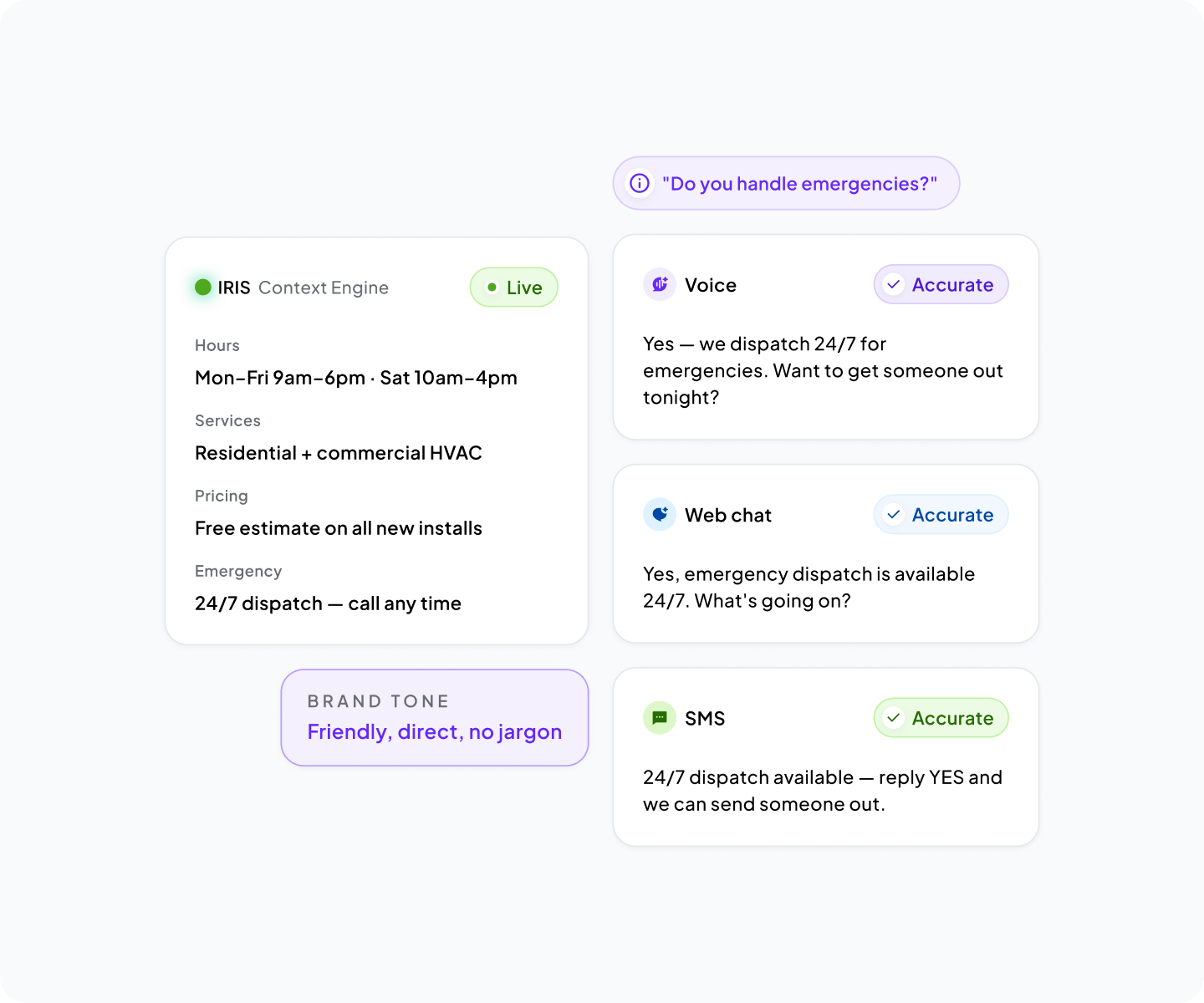
Your AI is only as good as
About you, specifically. A model can write a clean paragraph about anything and still have no idea who you are. Point it at a real customer and the gap shows.
Why most business AI answers like
Four ways an AI ends up confidently wrong about the company it is supposed to represent.

It starts every conversation as a stranger
No memory of your policies or what makes you different. It guesses. Sometimes the guess quotes a price you retired two years ago.

The context lives in ten places at once
Your real answers are scattered across a website, three inboxes, and one person's head. No single tool holds the whole truth.

Each channel improvises on its own
The chatbot says one thing. The phone agent says another. The email sequence says a third. That is not five tools. That is one company that cannot keep its story straight.

You cannot see what the AI thinks it knows
Most tools hide their memory inside a black box. You do not get to check it or correct it. You find out it was wrong when a customer does.
An AI that contradicts your brand does not read as a glitch. It reads as sloppiness.
Consistency is the whole difference between an AI that sounds like your business and one that sounds like a bot.
What an AI context engine
A living, structured model of your company's context that every AI touchpoint reads from before it responds. Not a folder of files. Not a memory that resets each chat. You have heard pieces of the idea under other names; the engine is more than any one of them, closer to a knowledge graph of your business than a search box bolted onto a chatbot.
The context mindmap: see it
Do not trust it blind. Most AI hides its context in a black box. We took the opposite path: our engineers built an agent plus a visual context mindmap, so you can see your company's context laid out as a map instead of guessing what the model absorbed.
One node for the company, and every fact Iris knows about it hangs off that node. It is the single source of truth for how your AI represents you: the one authoritative copy everything else reads from, so nothing drifts.
Each branch is a piece of context every channel consults before it speaks: what you sell, when you are open, what you charge, what you will not take on, and the voice it is all said in.
You open the map, find the branch, and fix it. The context stops being a mystery you inherit and becomes a thing you own and steer. That is the real differentiator: not that Iris has context, but that you can see it, shape it, and hold it to the same high standard on every channel, every time.
Four ways to feed the engine
A model of your business is only as good as what you put into it. Iris gives you four ways to load context, from a two-minute file drop to a real conversation. Use one. Use all four. The engine folds them into one map.

File upload
Drop in what you already have. Brand guides, pricing sheets, FAQs, the policy doc nobody outside the company has ever read. Iris ingests the files and maps what matters, so knowledge trapped in your documents becomes context your AI can use.

Website scraper
Point Iris at your website and it reads what is already public: your pages, your descriptions, the way you talk about the work. The site you already maintain becomes a starting draft of your context, instead of a blank page.

Custom prompts
Write context in directly. Correct a detail, add a rule, sharpen how Iris handles a touchy question. This is your steering wheel for exactly what Iris should know and how to say it.

A voice call with Iris
Here is the part no upload captures. You get on a call and talk through your business out loud, the way you would brief a sharp new hire on their first day. Iris asks questions, listens, and turns the conversation into structured context.
One model, the same answer on every channel
When every surface reads from one context engine, your business stops contradicting itself, whether a customer calls at midnight or reads an ad at noon. Every Iris feature reads from the engine: the AI CRM, the AI receptionist, AI voice, AI SMS, AI web chat, and AI calendar. Not six tools you keep in sync by hand. Six windows onto one truth.
Your front line

So it answers like someone who works there, not someone reading a script.
Your emails and follow-ups

The thread reads like one relationship, not a relay race between disconnected tools.
Your phone calls

What a buyer hears on the phone matches what pulled them in.
Your marketing and SEO

The voice a buyer meets on Google is the voice they meet on the phone.
How the context engine
No black box. Four steps, and you can see every one.
Ingest
You feed the engine context four ways: file upload, website scraper, custom prompts, and a voice call. Everything you know goes into one place.
Map
Iris turns that raw input into the visual context mindmap: your company, structured, with every branch and connection laid out for you to read.
Keep current
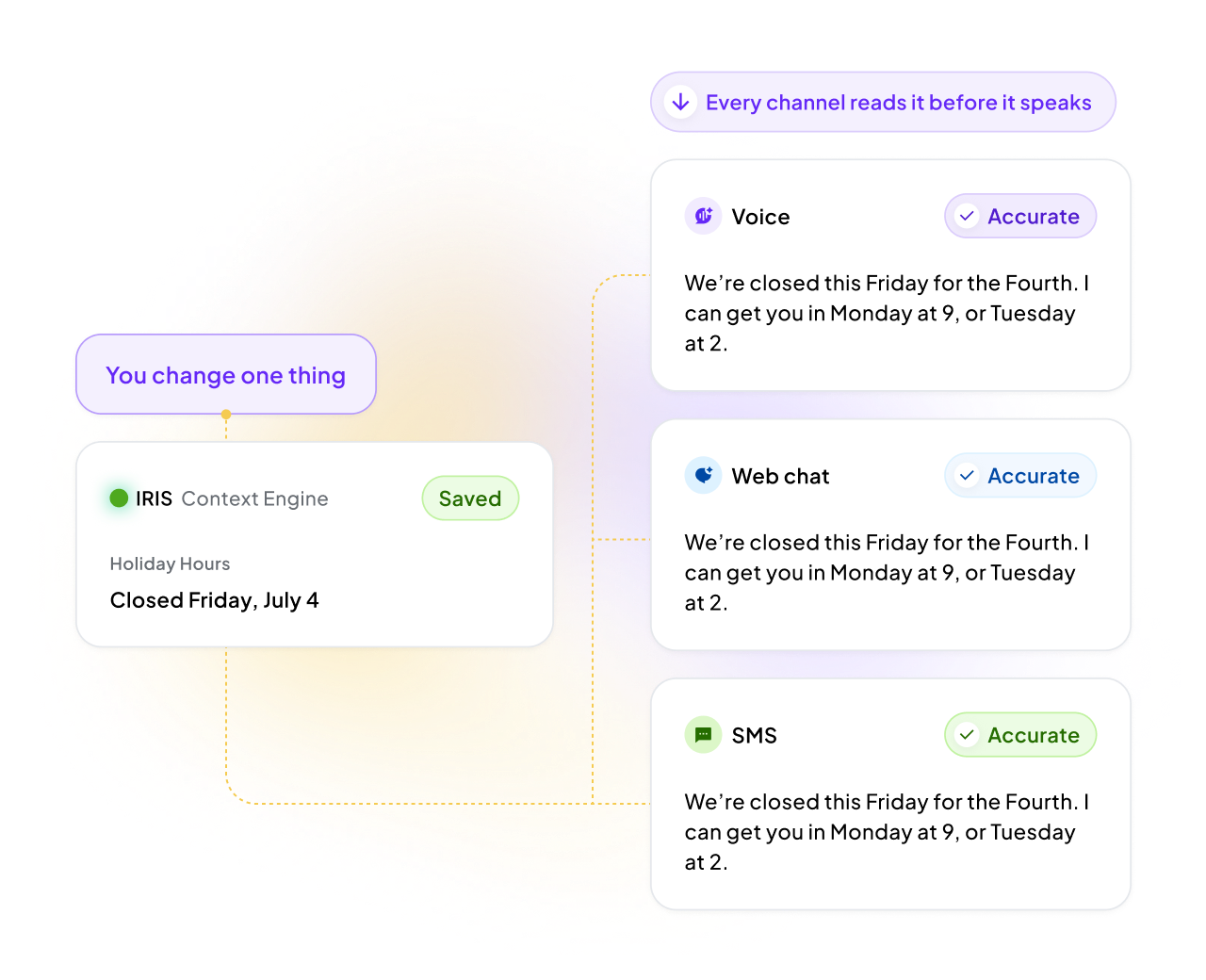
The agent maintains the model as things change. Update a policy or price once, and the correction flows to every surface, instead of you fixing the same fact in six tools.
Read from it
Every Iris feature reads from the engine before it answers. One model in. Consistent, on-brand responses out, on the call, the chat, the text, and beyond.
What the context engine does not ask you to give up
A model of your whole business is a serious thing to hand an AI. Here is what stays in your hands.
The context you load belongs to you. Iris is built to hold your company information responsibly and keep it protected, so a shared model of your business never means losing control of it.
The mindmap exists so you are never guessing what the AI absorbed. You open the map, read what Iris knows, and correct anything that is off. Visibility is the default, not a feature you request.
The engine handles what machines are good at: remembering everything and repeating it consistently. The strategy and the human calls stay with your people. You keep the judgment. Iris keeps the facts straight.
You do not have to model your whole company before Iris earns its keep. Drop in a few files, take one call, and refine from there. The map grows as you do.

Built by dotfun.
The context engine is not a feature we bought and rebranded. It came out of the context systems and agents Run Good builds for growth-stage companies. The engine and the mindmap are what that engineering looks like as product: we built the agent to keep your context current, and the map so you never have to trust a black box. That is the whole dotfun idea in one line: one source of truth, everywhere your business shows up.
An AI context engine in practice, not in theory
An AI context engine is a living, structured model of your company's context that every AI touchpoint reads from before it responds. A traditional AI tool answers from its general training and forgets you the moment the chat ends. A context engine holds one current model of your business and keeps every surface answering from the same truth. The point is not a smarter chatbot. The point is consistency: the same accurate, on-brand answer wherever a customer meets your AI.
An AI knowledge base stores documents so a bot can look things up. Useful, but passive. The Iris context engine models the relationships between your facts, keeps them current, and feeds every channel at once. A knowledge base is a filing cabinet. A context engine is a living model that reads from it and keeps every surface in sync, closer to a knowledge graph of your company than a folder of files.
The context mindmap is a visual map of everything Iris knows about your business, with your company at the center and branches out to your services, policies, pricing, and voice. It exists so you never have to trust a black box: instead of guessing what the AI absorbed, you open the map, read what Iris knows, and fix anything wrong or missing.
Four ways, and you can mix them. Upload your files. Point the website scraper at your site so Iris reads what is already public. Write custom prompts to add or correct detail directly. Or get on a voice call and talk through your business out loud, and Iris turns that conversation into structured context, the one method most tools never offer.
Because every surface reads from the same model. When your receptionist, follow-up texts, web chat, and marketing all pull from one context engine, they cannot drift apart. Update a fact once and the change reaches every channel, so a buyer hears the same voice on the phone that they read in your ad.
The context you load into Iris belongs to you. Iris is built to hold your company information responsibly and keep it protected, and the mindmap means you can always see and control what the engine knows. A shared model of your business should never cost you control of your data.
No. The four ingestion methods are built for operators, not engineers: upload a file, point the scraper at a site you already have, type a prompt, or talk to Iris on a call. You shape your context by reading and editing a map, not by writing code or managing a database.
All of them. The context engine is the shared substrate underneath the AI CRM, the AI receptionist, the AI voice agent, AI SMS, AI web chat, and the AI calendar. Each reads from the same model, which is why they stay consistent instead of each improvising its own version of your business.