
The electrician answering service that separates hazard calls from quote requests
Your phone line carries every kind of load on one circuit: the burning-smell call at 9 PM, the panel-upgrade quote. Iris flags hazard language and escalates those callers to your on-call electrician; routine work gets qualified and booked. Iris never gives electrical advice. It routes.
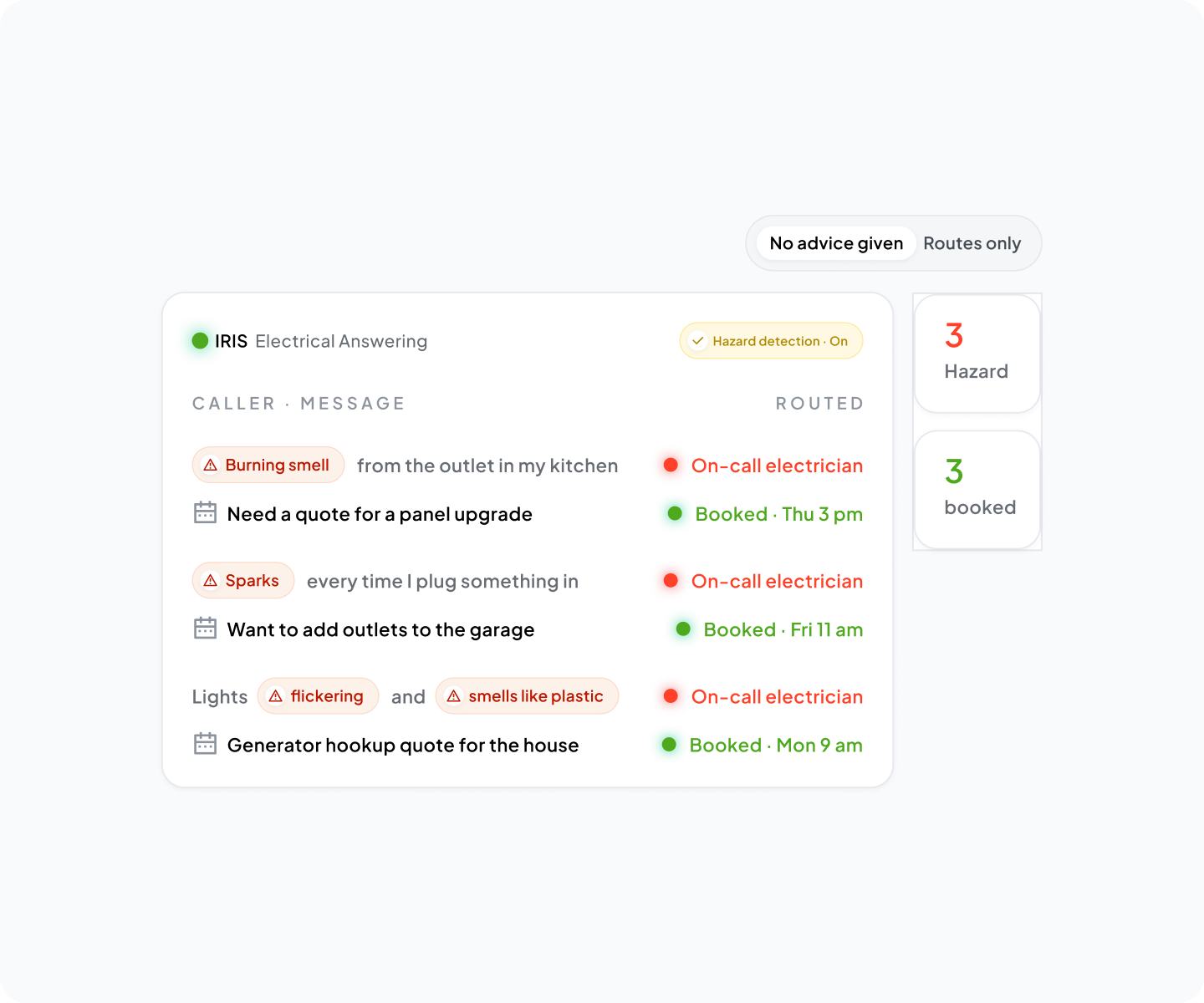
One line,
The 4 PM caller wants a ceiling fan hung. The 9 PM caller smells something hot behind the breaker panel. Same line. Same ring. Very different consequences when nobody picks up. And you are usually the reason nobody picks up: on a ladder, in a crawl space, or working live equipment. Two hands on the work means zero hands on the phone. The overload shows up in three places.

The after-hours hazard call
A caller with a sparking outlet does not leave a voicemail and wait for morning. They keep dialing licensed names until one answers, and the first answer usually gets the job.

The mid-job quote request
Panel upgrades, EV chargers, remodel wiring. Scheduled, profitable work that books with whoever responds first while you are on the previous job.

The message pile
A basic service writes everything down at the same speed and weight. A hot breaker and a ceiling-fan quote land in the same stack, and the sorting falls back on you at 7 PM.
Hazard calls trip straight to a human
After-hours electrical work bills at time-and-a-half to double the standard $50 to $130 hourly rate, plus a trip charge, according to HomeAdvisor. The night call you miss is often the best-paying call of the day. Sometimes it is also the most dangerous one. Iris runs triage on every call using rules you write, at 2 AM the way it does at 2 PM.
A flag trips
Certain language flags a call as a potential hazard: no power, a burning smell, a sparking outlet or panel, water near electrical equipment. When a flag trips, Iris stops routing toward the calendar and starts routing toward people.
Iris routes toward people, not the calendar
It captures the service address, the symptom in the caller's own words, and a callback number, then notifies your on-call electrician immediately. Three calls at once land as three handled conversations.
The line Iris does not cross
It never advises the caller on the hazard itself. No troubleshooting. No guessing whether something can wait until Monday. No instructions about the panel. Judgment about electrical safety belongs to a licensed electrician, so the software's entire job on a hazard call is speed.
That caution is earned.
NFPA research counted an annual average of 32,620 home fires involving electrical distribution and lighting equipment across 2015 to 2019. When a call could belong in that category, escalation rules should err toward a person. Iris follows yours exactly. That is the difference between an electrician answering service that transcribes and one that triages.
What Iris does for an electrical business
Iris answers, triages, books, follows up, and files the job. That is why you run an AI growth system where the phone was.
The AI receptionist and AI voice layer picks up in seconds with your company name, works through your intake questions, and applies your hazard rules on the spot. An AI receptionist for electricians that knows which calls cannot wait.
The homeowner comparing EV-charger installers at 11 PM is on your website right now. AI web chat answers their questions, captures project details, and books the estimate instead of leaving a contact form to abandon.
Iris connects to your calendar and offers real open slots. The panel-upgrade quote gets a confirmed appointment before the caller hangs up, not a promise that someone will call back.
Appointment confirmations, reminders, and post-visit follow-ups go out automatically over SMS. Fewer no-shows on estimates, no chasing from the driver's seat between jobs.
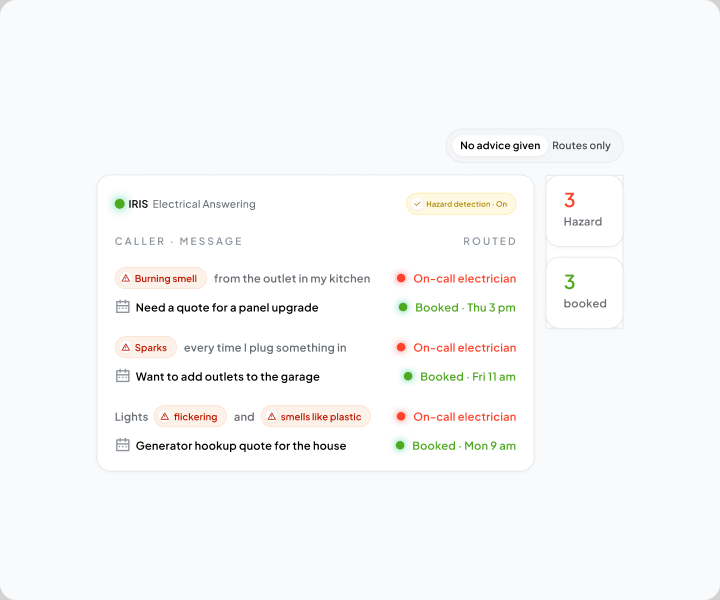
Who called, what they reported, what got booked, who got paged. Every conversation ends up in the AI CRM as a structured job record that feeds the tools you already run.

One call,
Every conversation starts the same way. Iris answers with your greeting, gets the caller's name, and listens for what the call is about. Then it branches. Either way, the call ends handled instead of stacked in a pile you sort after dark.
Triage is one branch. The system is the
The hazard path gets the attention. The rest of the load is where the business runs. Behind both branches sits one set of wiring: the same intake questions, the same on-call map, the same customer history, read by voice, web chat, SMS, and the calendar alike. That is why the quote you send for a service upgrade already knows about the burning-smell call in February, and why a caller who texts on Tuesday does not have to re-explain Monday's outage. An electrical business does not need one more inbox to check.
What stays true when Iris takes your calls
You have earned some skepticism about software that touches your phone line. These four things hold.
No diagnosis, no advice about a panel or an outlet, no telling a caller their problem can wait. Hazard calls route to a licensed human every time. That rule is built in, not configured.
What counts as a hazard, who is on call tonight, what gets paged now versus booked for morning. Iris executes your rules exactly. It does not improvise new ones.
Iris asks the questions you would ask: what the breaker does when it is reset, which rooms went dark, what the caller smelled and where, how old the home is. You arrive with the picture instead of rebuilding it at the door.
You configure it once, from a browser. Iris connects to your existing calendar, hands your systems structured job records, and starts answering while competitors return voicemails.
Built by dotfun.
Run Good built Iris because service businesses lose real revenue at the phone. Automating those businesses is what the practice does for dotfun clients the rest of the week. Our Feel Good growth side sees the same pattern in the marketing data: the fastest response wins the job. Need something Iris does not do out of the box, like custom wiring into a dispatch platform? That becomes a bespoke AI Solutions project, engineered in-house at dotfun.
Built for the businesses carrying the
From one truck to a multi-crew operation, the pattern is identical: the person qualified to answer the phone is the person least able to reach it.
Solo electricians and small service shops
When you are the whole company, every ring interrupts billable work. Iris is the answering service for electricians who have no office at all: it holds the phone while you hold the work, escalates the calls that need you now, and books the rest around your schedule.
Electrical contractors
Multiple crews, commercial accounts, and an on-call rotation. You map which calls reach which person, and Iris follows that map instead of building a message pile. Run plumbing or HVAC crews under the same roof? The home services page covers the full trades operation.
Simple Pricing That Pays For Itself
Most teams compare Iris to a $3k–$5k/month receptionist hire. We prefer a simpler benchmark: one saved job can cover the month.
How an electrician answering service should behave
Through triage rules you approve before launch. Language such as no power, burning smell, sparking outlet, or water near the panel flags the call as a potential hazard. Iris then captures the address, the symptom in the caller's own words, and contact details, and notifies your on-call electrician immediately. Flagged calls never sit in a message queue.
No, and that is deliberate. Iris does not troubleshoot, does not tell a caller their problem can wait, and does not give instructions about panels, outlets, or wiring. Safety judgment belongs to a licensed electrician. On a hazard call, the job of the software is speed: capture the details and get your human on it immediately.
A traditional service puts an operator between the caller and a message pad. Every call gets transcribed at the same speed with the same weight, and the urgency judgment happens later, when somebody reads the pile. Iris makes the routing decision during the call: hazard language trips your escalation rules on the spot, and routine work gets booked on your calendar. Because it is software, it answers in seconds at any hour and takes several calls at once.
Two models dominate electrician answering service pricing. Traditional services bill per minute or per call, so the cost climbs with your call volume. AI services bill flat monthly rates, and incumbents in this market advertise entry prices as low as $29 per month, though advertised rates are marketing numbers rather than quotes. Compare on what a call becomes: a message you still have to work costs more than its sticker suggests, while a booked job pays for the month.
Yes. You define the intake questions and Iris asks them: what the breaker does when it is reset, which rooms lost power, what the caller smelled and where, the age of the home, panel details if the caller knows them. The answers land in the job record with the address and contact information, so you show up ready instead of starting the interview at the door.
That is the routine branch working as designed. Iris connects to your calendar, offers real open slots, books the estimate or visit before the caller hangs up, and sends a text confirmation plus a reminder. The 11 AM quote request no longer waits for your 6 PM callback, and the caller has no reason to keep dialing your competitors.
You do not need a custom build to triage hazards, book panel work, or keep a job record; Iris ships with all of it. Custom is right when something in your operation has no equivalent elsewhere: location-aware on-call rotation, or call data driven into one dispatch platform. dotfun's AI Solutions team takes those on while your line keeps getting answered.