
The HVAC answering service built for the days the forecast fills your phone lines
Your call volume has a forecast: the first 95-degree afternoon, the first hard freeze, a season of calls in a single day. Iris answers all of them at once, sends no-heat calls, gas smells, and CO alarms to your on-call tech, and books the rest.
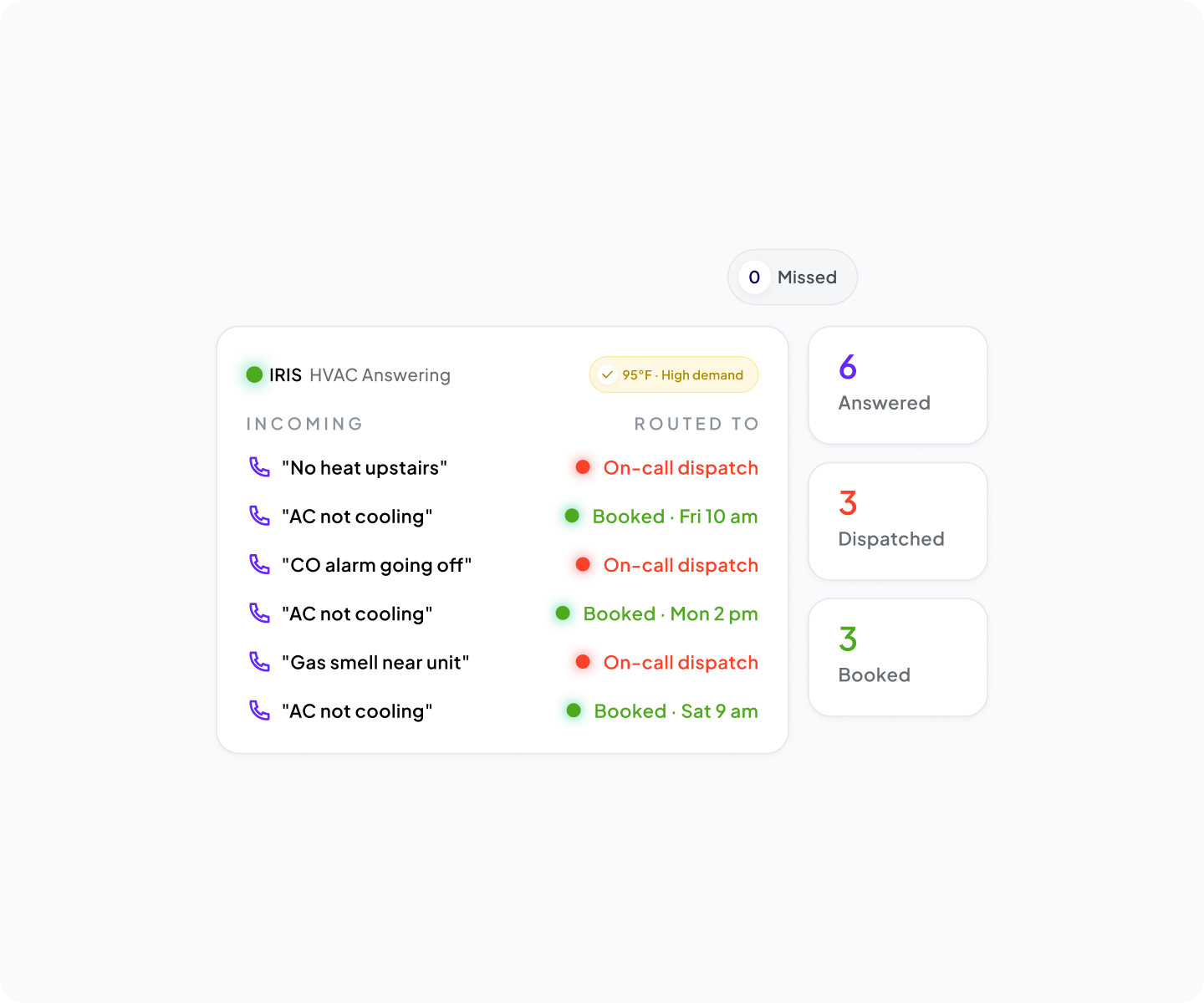
Where HVAC calls
No other trade can read its phone traffic off a weather app. Cooling demand peaks in July and August; heating flips the pattern in winter. Your phone follows the thermometer either way, and it surges on the exact days your competitors' phones surge too. You can see the surge coming three days out. Your phone line cannot.
The first brutal afternoon of summer.
A season of AC failures lands in one day. One line, one dispatcher, and callers hearing rings instead of answers.
The tenth caller gets the same answer as the first.
Iris answers every simultaneous call in your company name, applies your emergency-versus-maintenance rules, and books the routine majority while the surge is still running.
The 2 a.m. no-heat call in January.
Nobody staffs a night desk for a spike that comes a few weeks a year, so the coldest calls of the season reach nobody.
Your on-call tech is woken with the address and symptoms.
No heat in freezing weather matches your emergency criteria, so Iris escalates immediately with everything captured. Iris routes hazard calls fast; it does not coach callers through them.
You are on a rooftop, mid-changeout.
Hands full, gauges on, phone buzzing in the truck. That caller does not try again tomorrow.
Answered in seconds while your hands stay on the work.
The tune-up, the noisy-condenser visit, or the replacement estimate goes onto your real calendar while the caller is still on the line, then gets confirmed by text.
The shoulder-season whiplash.
Quiet weeks train you to run lean. Then the freeze hits, and the lean setup is the reason the surge gets away.
Capacity does not run out because the temperature moved.
Iris holds the surge at the same size whether it is April or the first hard freeze, so the lean setup that gets you through the quiet weeks is never the reason you lose the loud ones.
What Iris does for HVAC companies
An answering service for HVAC companies has two jobs: hold the surge, sort it. Iris does both. Because it is an AI growth system built for surge weeks, it answers every simultaneous call, applies your emergency-versus-maintenance rules, books the routine work, and leaves a job history, not a call log.
The AI receptionist and voice layer pick up in seconds, in your company name and tone. The tenth simultaneous caller during a heat wave gets the same immediate answer as the first. Capacity does not run out because the temperature moved.
You define what counts as urgent. No heat in freezing weather, no cooling with at-risk occupants, a gas smell, a CO alarm: those calls escalate to your on-call tech immediately, with the address and symptoms captured. Iris routes hazard calls fast; it does not coach callers through them.
The non-urgent majority of a surge is future revenue. Iris connects to your scheduling calendar and books the tune-up, the noisy-condenser visit, or the replacement estimate while the caller is still on the line.
Booking confirmations, appointment reminders, tech-on-the-way updates: Iris sends them over SMS automatically, which keeps a packed surge-week schedule from leaking to no-shows.
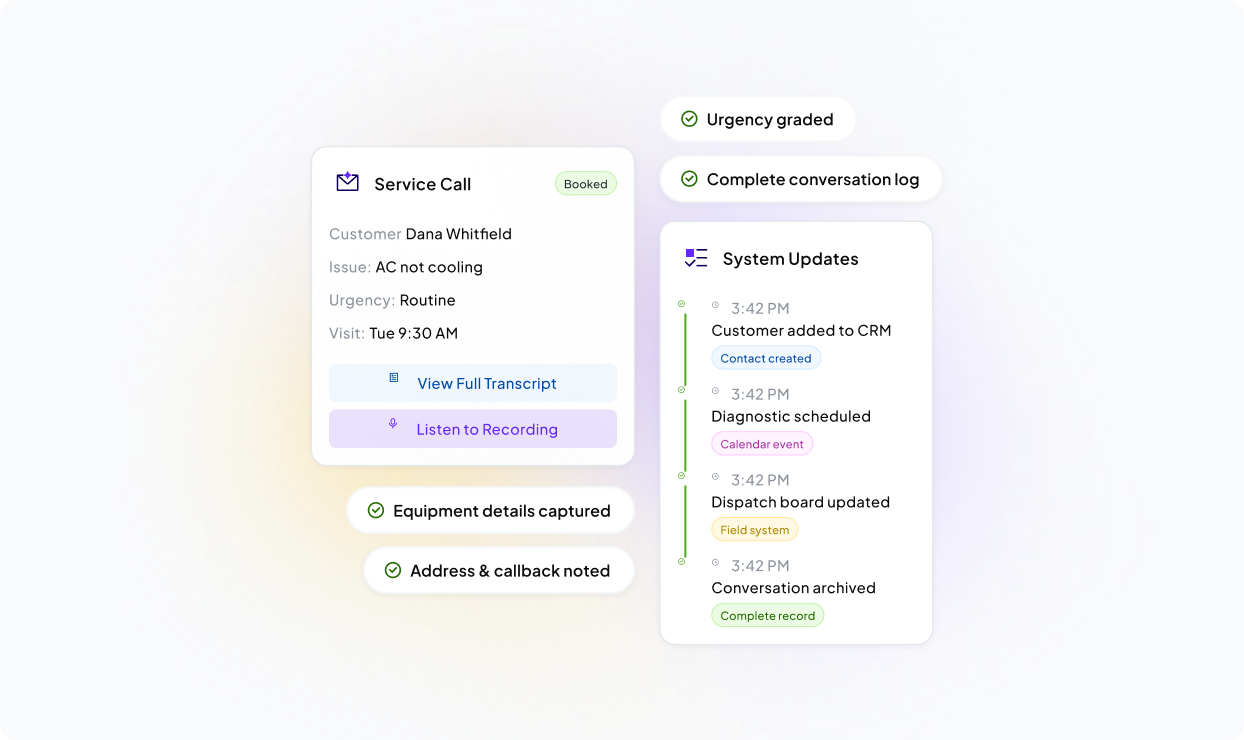
The homeowner comparing three HVAC companies at midnight often starts on your site, so web chat captures and qualifies them too. Every call, text, and chat lands in the AI CRM with the equipment, the symptom, and the booked time attached, so the job history gets written while the surge is still running.

The calls that decide your season
Staffing a human night desk for a spike that peaks a few weeks a year rarely pencils out, so after-hours is the most expensive gap in the trade. Iris runs 24/7 with no night surcharge logic: the triage rules you set for 2 p.m. apply at 2 a.m. True emergencies wake your on-call tech with full details, and everyone else gets booked into tomorrow's schedule. Your tech loses sleep for the gas smell, not the filter question.
What your worst week is worth in October
A surge is not only a week of invoices. It is a list. Most companies lose that list, because it exists as scribbled dispatch notes and whatever the tech remembers. Iris does not lose it: the conversation, the diagnosis the caller described, and the visit you booked stay together, so when you work your maintenance-agreement calls in the fall, you start from what the customer told you in July.
Homes running equipment on borrowed time
Ten hard days tell you which systems limped through the season. Each one is logged with the symptom the caller described and the visit you booked, not a line on a notepad.
Callers who deferred a replacement
The homeowner who said "not this year" in July is still a record in October, with the estimate you gave and the reason they waited attached.
Units one season from a changeout
That memory is why we built the answering layer on top of a CRM instead of beside one. We would rather hand you the list than another phone line.
How Iris handles an HVAC call
Same loop on every call, whatever the forecast is doing.
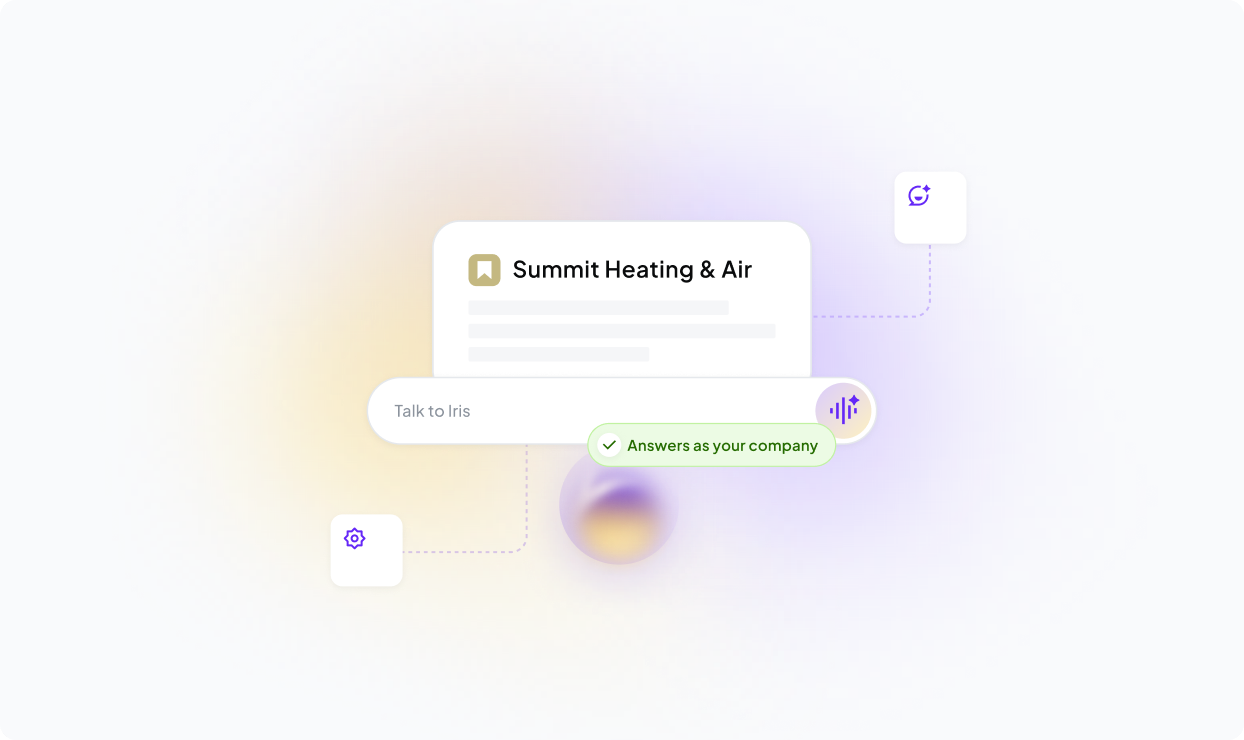
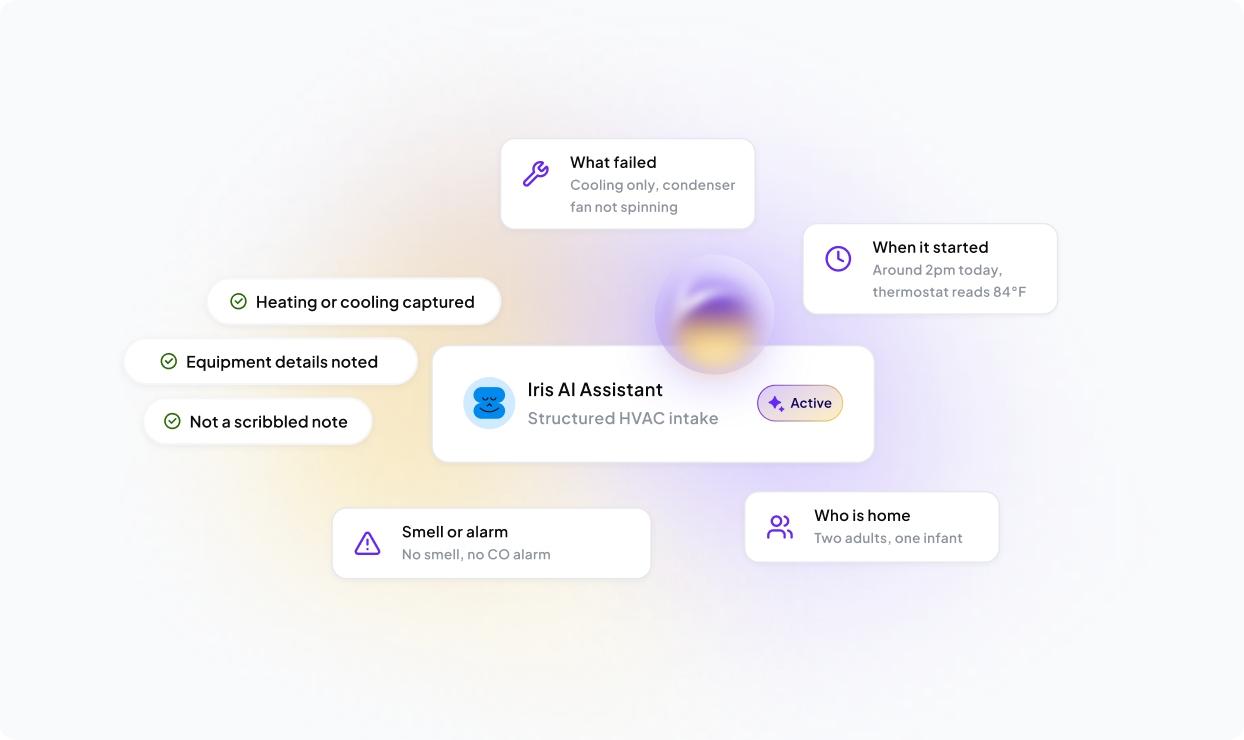
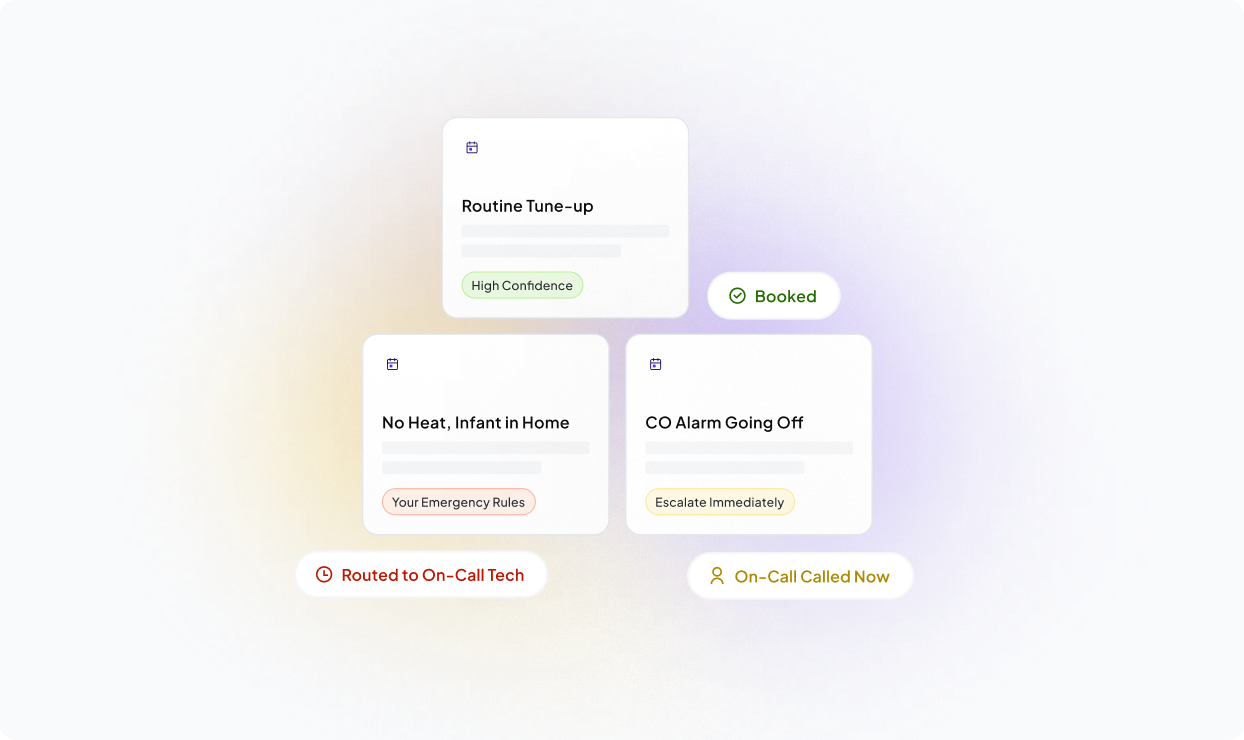
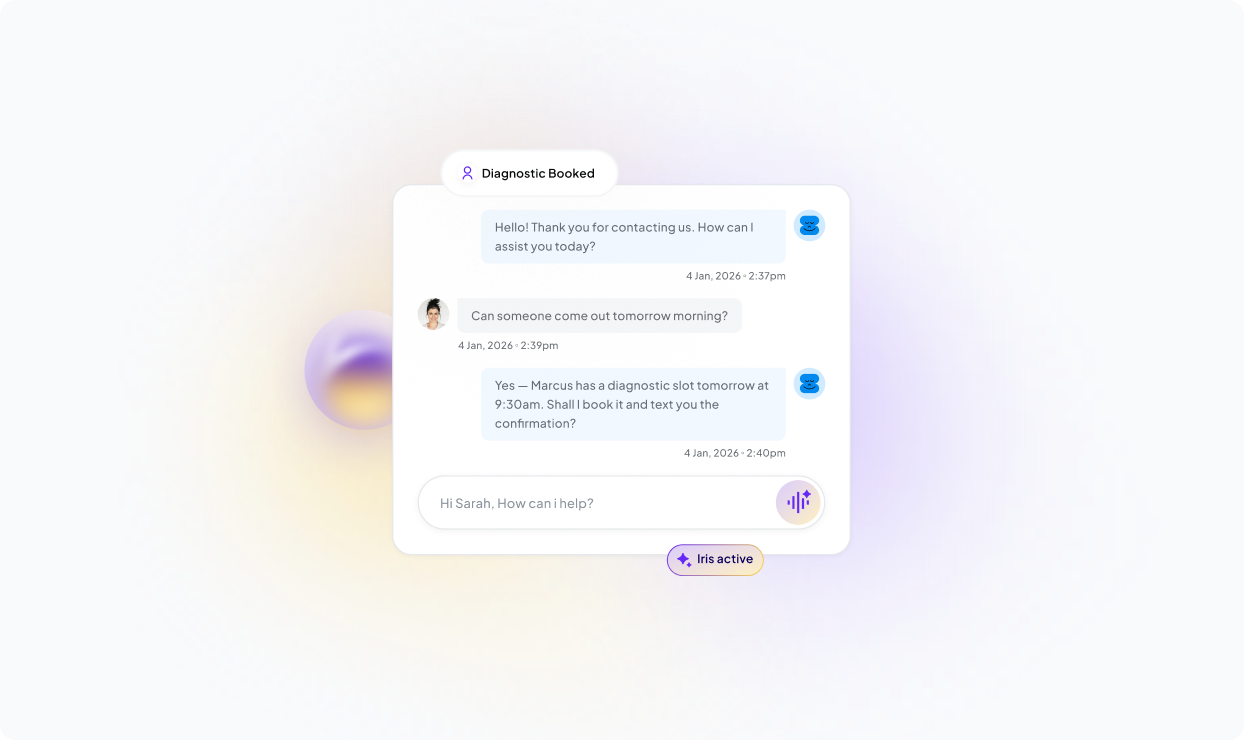
The phone rings when the weather turns.
The companies that win a season are the ones answering during its ten worst days.
Live answering, virtual receptionist, or
The weather stresses each one differently. Where human judgment matters, Iris does not pretend: it escalates to your people, by your rules. That honest split, machine capacity with human escalation, is the fit for a trade whose demand arrives with the weather.
How Iris behaves when July arrives
You have a dispatch routine that survives July. Iris slots into it.
Iris does not ask you to change how you run jobs. It answers and qualifies the call, books on your calendar, and hands your field-service stack a structured record your dispatcher can act on without a callback.
Gas smell, CO alarm, no heat in a freeze: you decide what escalates and who gets woken. Iris routes those calls to your on-call tech immediately, and it never plays safety advisor on the line.
Nothing to install. The onboarding is a conversation about how a season runs and who gets woken at 2 a.m. No project standing between you and the first heat wave.
Your name, your tone, your service area. And the call records Iris captures belong to you, with recording disclosures configurable where your state requires them.

Built by dotfun.
Iris was built inside Run Good, the part of dotfun that automates service businesses for a living. On the growth side we see the same pattern across the trades: the seasons an HVAC company remembers are the ones where the surge got answered. Need something past the product, like deep dispatch-stack wiring or multi-branch routing? dotfun's AI Solutions practice builds exactly that, with the engineers who built Iris.
Built for one truck
Residential service, light commercial, maintenance-agreement books, new-install estimates: the pattern holds from a solo owner-operator to a multi-crew shop, because the weather does not scale its demands to your headcount. Iris runs the same first response across the broader trades too.
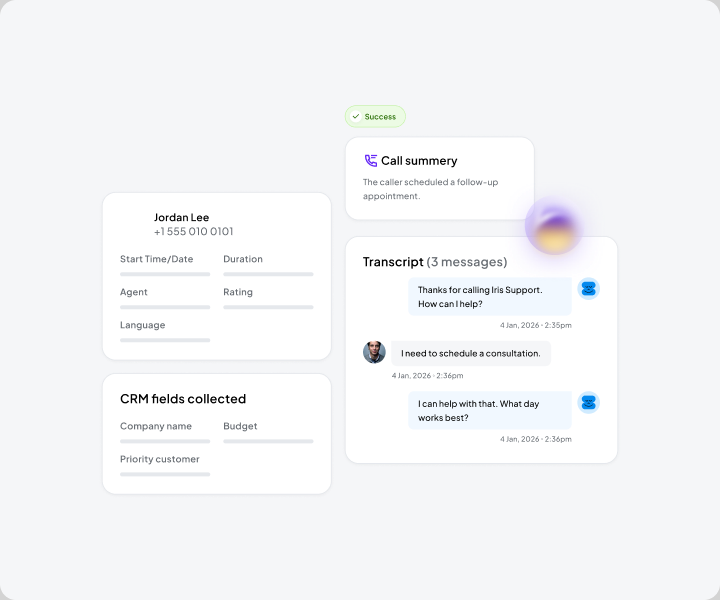
Home services
Running plumbing or electrical crews under the same roof? The broader answering service for home services page covers the full trades operation.
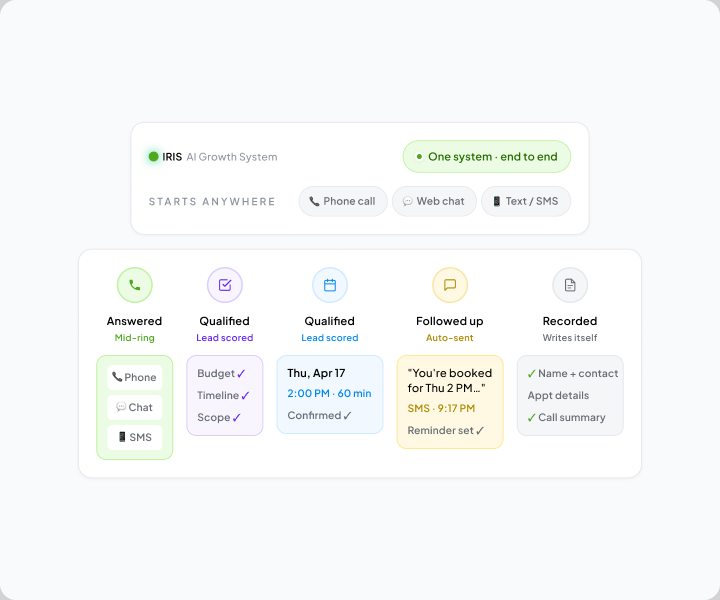
Every industry
Plumbing, electrical, dental, contractors, property management and more: browse every vertical Iris is tuned for on the Iris hub.
Simple Pricing That Pays For Itself
Most teams compare Iris to a $3k–$5k/month receptionist hire. We prefer a simpler benchmark: one saved job can cover the month.
Everything an HVAC answering service has to survive
An HVAC answering service runs $135 to $450 per month for small-business live answering, around $1.50 per minute on per-minute plans, or $0 to $200 monthly for AI, with the AI range depending on usage (all three figures from Housecall Pro's cost guide). Watch the billing model more than the sticker: per-minute pricing charges the most in exactly the weeks the weather multiplies your volume. Model your July and your January, not your April.
The difference is capacity: Iris holds every simultaneous call, while a traditional service is staffed for average volume and breaks on the days HVAC companies buy it for. Operators queue during a heat wave, and per-minute billing turns your busiest week into your most expensive one. Iris applies your emergency-versus-maintenance triage rules and converts the non-urgent majority into booked visits on your calendar. Surge capacity and triage judgment are the product, not an upsell tier.
By the rules you set. No heat in freezing weather, no cooling with at-risk occupants at home, a gas smell, a CO alarm: calls matching your emergency criteria escalate to your on-call tech immediately, with symptoms and address captured. A noisy condenser, a tune-up request, or a filter question becomes a scheduled visit instead. Iris routes hazard calls; it does not give safety instructions on them.
Every caller gets answered. Iris takes simultaneous calls across voice, SMS, and web chat, so there is no busy signal and no hold queue when the forecast dumps a season of demand into one afternoon. Emergencies dispatch to your on-call tech as they arrive; everyone else gets booked in order. The surge leaves you with a full schedule, not a full voicemail box.
Yes. Iris works as a 24/7 HVAC answering service, and the after-hours calls get the same triage as daytime ones. A true emergency at 2 a.m. wakes your on-call tech with full details; a routine caller gets booked into the morning schedule instead of dialing the next company. Nights, weekends, and holidays are when the season's emergency work concentrates. That coverage is the point.
Yes. Iris connects to your calendar and books the visit while the caller is on the line, then confirms by text. If you run ServiceTitan, Housecall Pro, or Jobber, Iris hands your stack a structured record (caller, equipment, urgency, booked time) so your dispatcher works the job instead of calling the customer back for the basics.
Look at the calendar first. If the next heat wave is closer than the next quarter, run Iris; it answers this week. Save the custom question for a slow season, when scoping is cheap: multi-branch routing by service area, a dispatch stack driven directly, renewal automations built around your maintenance agreements. That is when AI Solutions scopes a build for you.