
The plumbing answering service that picks up before the damage spreads
A water heater lets go at two in the morning, and that caller does not leave a voicemail. Iris picks up in seconds, runs a calm structured intake, dispatches your on-call plumber when it is urgent, and books the job when it is not.
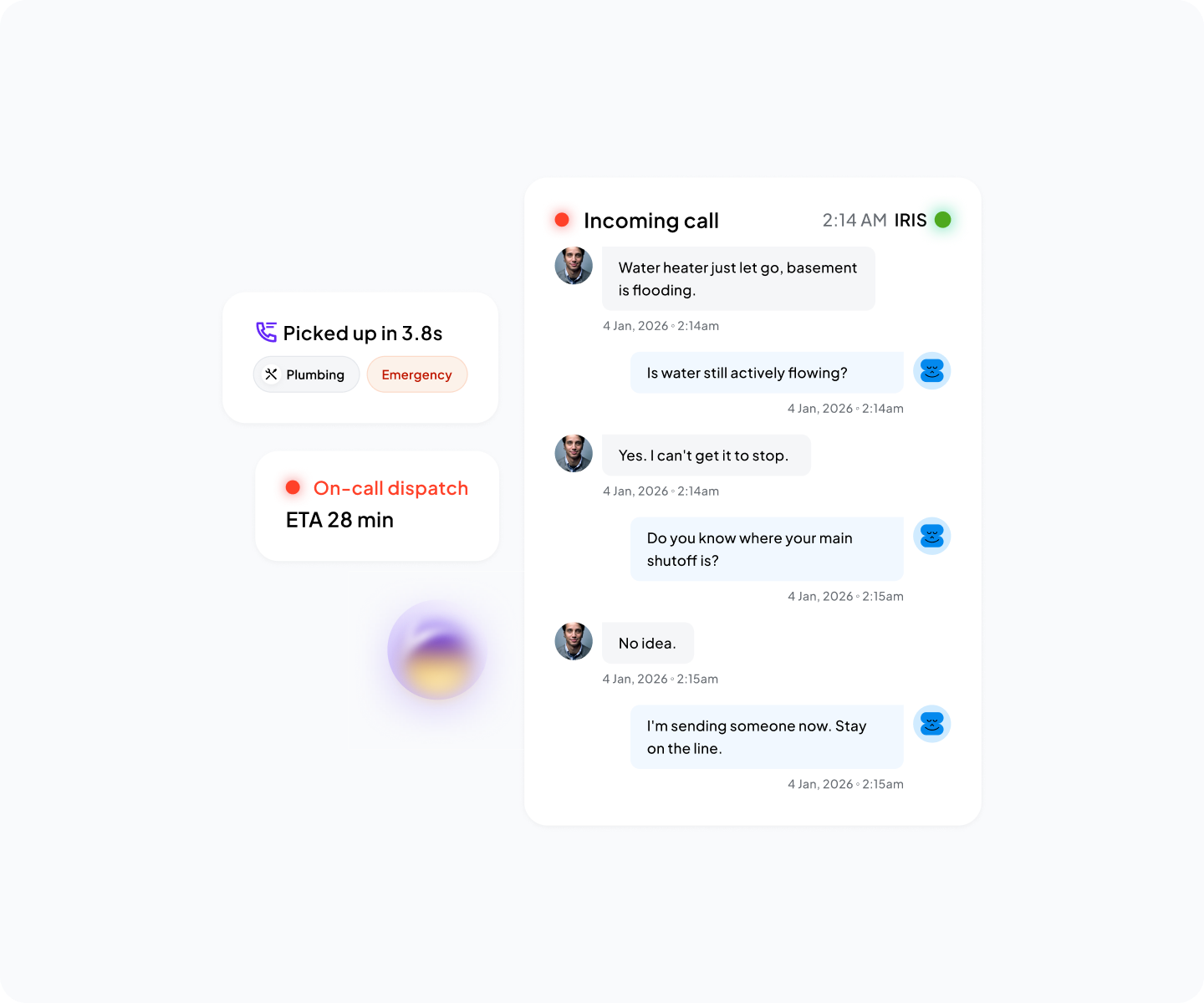
Two meters, one ring tone.
While your phone rings, the meter is running. Plumbing is the trade where a missed call is measured in gallons: water keeps moving whether or not anyone picks up, and the person watching it spread across their floor will not wait through six rings. The money runs the other way too. The after-hours call you miss was probably your highest-rate job of the week.

average water-damage and freezing claim (Insurance Information Institute)
of all homeowners insurance losses in 2023 were water damage or freezing
average emergency plumbing rate, double time on weekends, triple on holidays (Today's Homeowner)
Where plumbing calls
You cannot answer a phone with a wrench in your hand. Somebody has to.
You are elbow-deep in the work.
Wet hands under a slab, half a drain line on the floor. Nobody stops mid-repair to qualify a stranger's leak.
Answered in seconds, in your company name.
Iris picks up on the first rings, runs the intake a dispatcher would run, and hands you a structured job with address, urgency, and details, not a phone number and a guess.
After five, the phone is a pocket on a ladder.
The on-call plumber cannot answer every ring, and the caller with sewage rising in a finished basement gives you one try before dialing the next name.
The on-call plumber gets the job, not a ring.
A true emergency routes straight to your on-call plumber with full context, and the caller gets a text that help is coming instead of dialing your competitors from the driveway.
Urgent buries routine.
Water heater replacements, repipes, slow drains: the profitable scheduled work goes to voicemail while you chase the flood of the day. Voicemail does not book jobs.
The repipe gets booked while you chase the flood.
Routine work goes onto your calendar as a booked appointment before the caller hangs up, so the scheduled jobs that pay the month stop leaking while you handle the emergency that pays the day.
Nobody calls back a stranger fast enough.
A note that says "leak, call back" is already stale. By the time someone works through the pile, another plumber answered live and took the job.
Confirmed by text before they dial the next name.
Confirmations, reminders, and on-the-way updates go out automatically, and every exchange is filed as a job record carrying the address, what failed, and what you did about it.
What Iris does for a plumbing company
A plumbing answering service at the front, a working job record behind it. Message-taking is not what this is; it is an AI growth system that acts on the call.
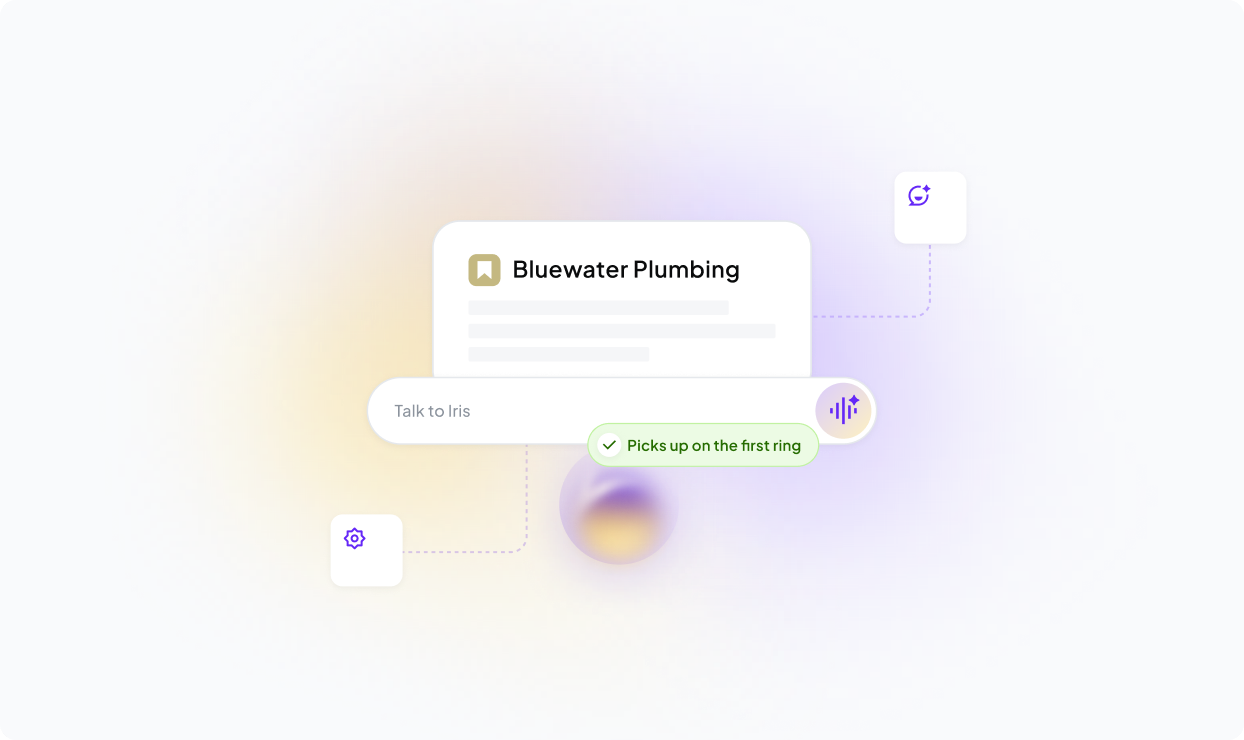
The AI receptionist and AI voice layer picks up on the first rings with your company name, at noon and at 2 a.m., and holds several conversations at once. No hold music. No voicemail.
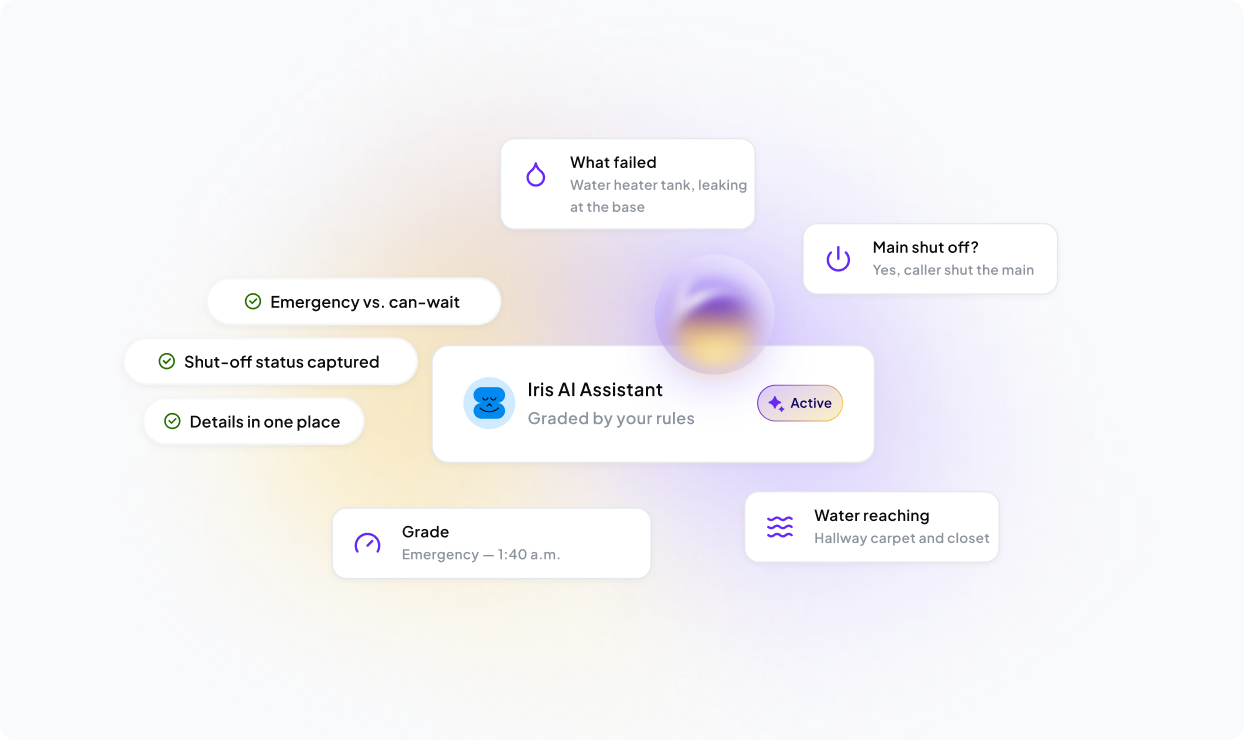
Iris asks the questions that decide the next move: What is leaking? Is the main shut off? Is water still coming in? Where is it pooling? You get a structured job with address, urgency, and details, not a phone number and a guess.
A true emergency routes straight to your on-call plumber with full context. Routine work goes onto your calendar as a booked appointment before the caller hangs up.
Confirmations, reminders, reschedules, and on-the-way updates go out automatically over AI SMS. Fewer no-shows, fewer "where is he" callbacks interrupting your day.
The homeowner comparing plumbers at 11 p.m. usually leaves without calling anyone. AI web chat meets them on your site and captures the job before they open a competitor's tab.
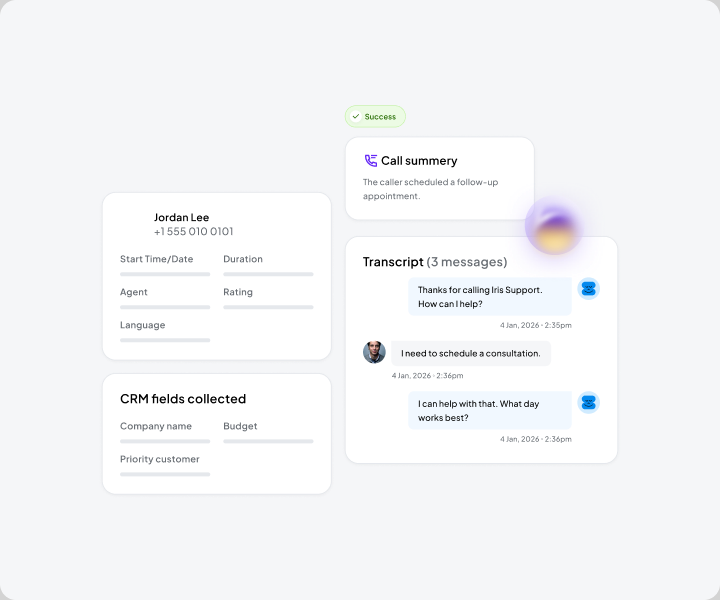
Voice, text, or chat, the exchange is filed in the AI CRM as a job record carrying the address, what failed, and what you did about it. The history belongs to the customer, not to whoever answered.

How Iris handles an after-hours plumbing emergency
Take the classic: 1:40 a.m., a water heater tank fails, and a garage is flooding.
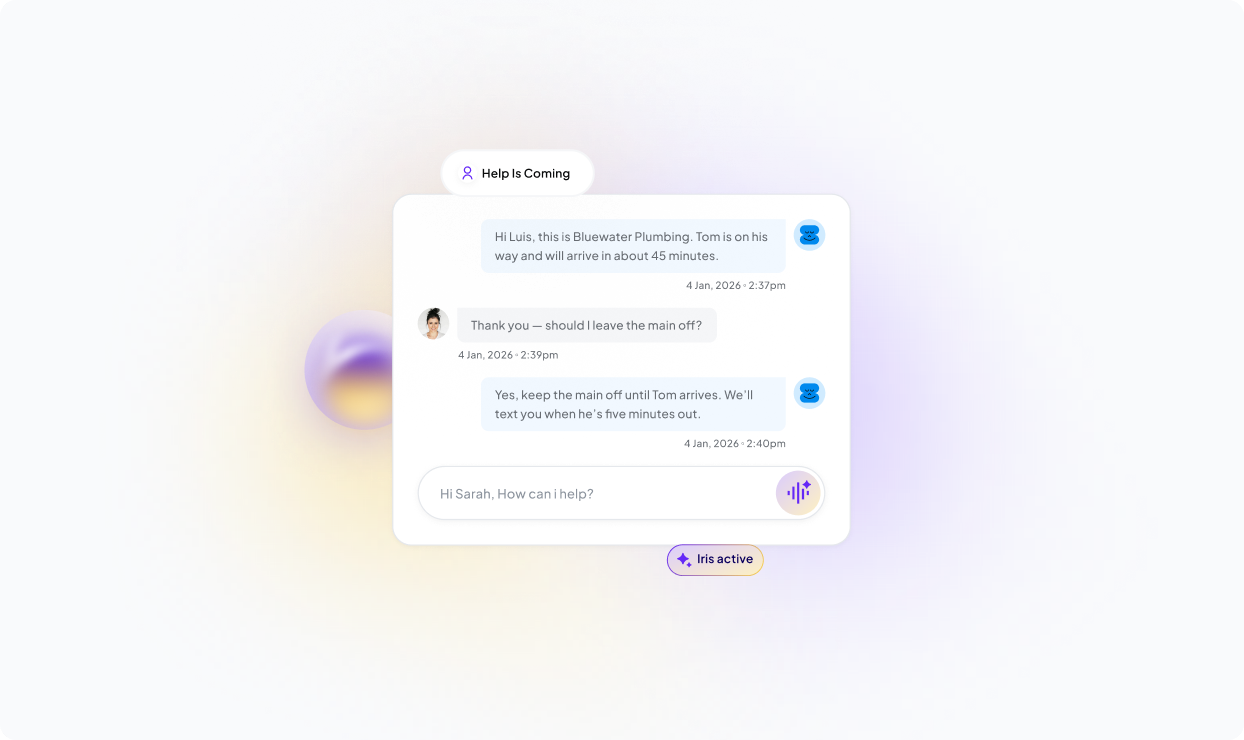
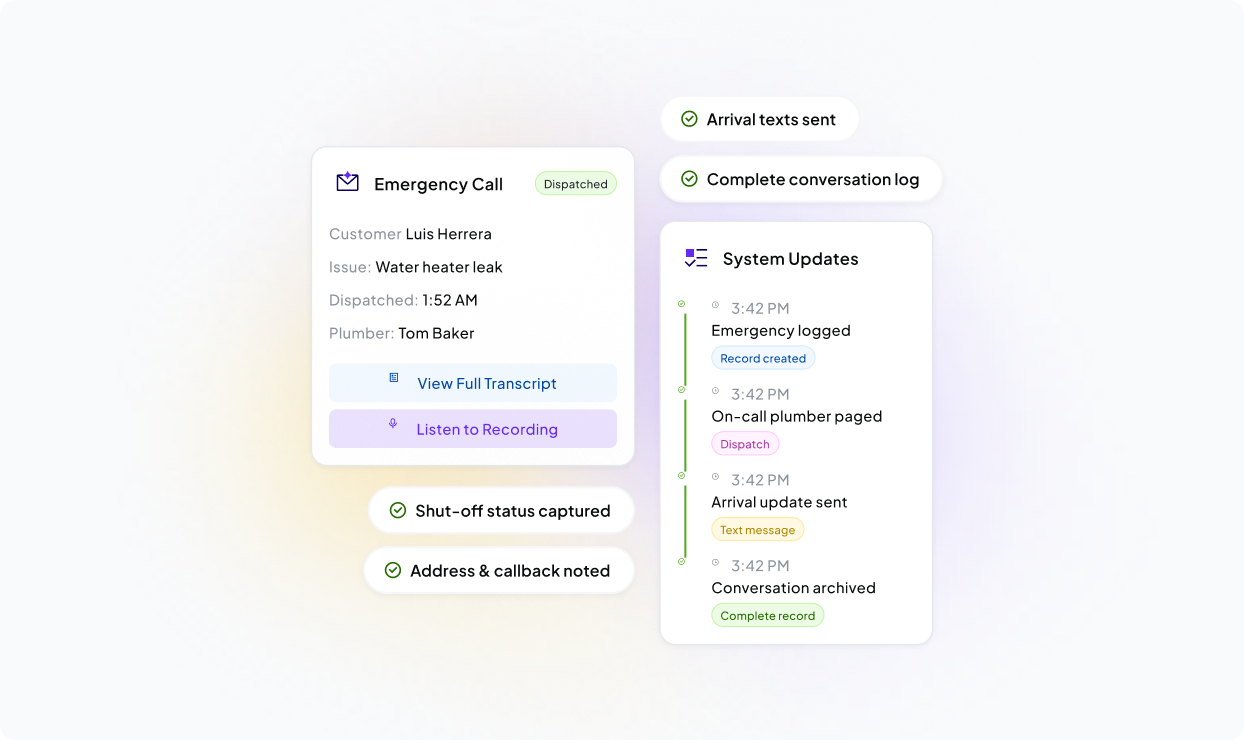
By seven, that 1:40 a.m. call belongs to
The plumber who took it is asleep. The office is opening. The customer wants to talk about the repipe you mentioned while the garage was still filling. Iris makes that handoff clean: the intake answers, the dispatch, the texts, and the outcome sit in one record, filed against the customer for whoever picks the job up next. The emergency pays once, and the record is how it pays again in March.
The call that cannot wait.
That job bills at emergency rates, and it belongs to whoever answers first. With Iris, that is you.
What actually
Humans still win the messiest conversations: the distraught caller, the judgment call with no script. If your volume is mostly delicate edge cases, hire humans. Plumbing volume is urgency, repetition, and speed, and that is the game AI wins. Iris plays it with an escape hatch: machine speed on every ring, human judgment where it counts.
Where your control actually sits
Handing a stranger your phone line is a trust decision. Here is what stays in your control.
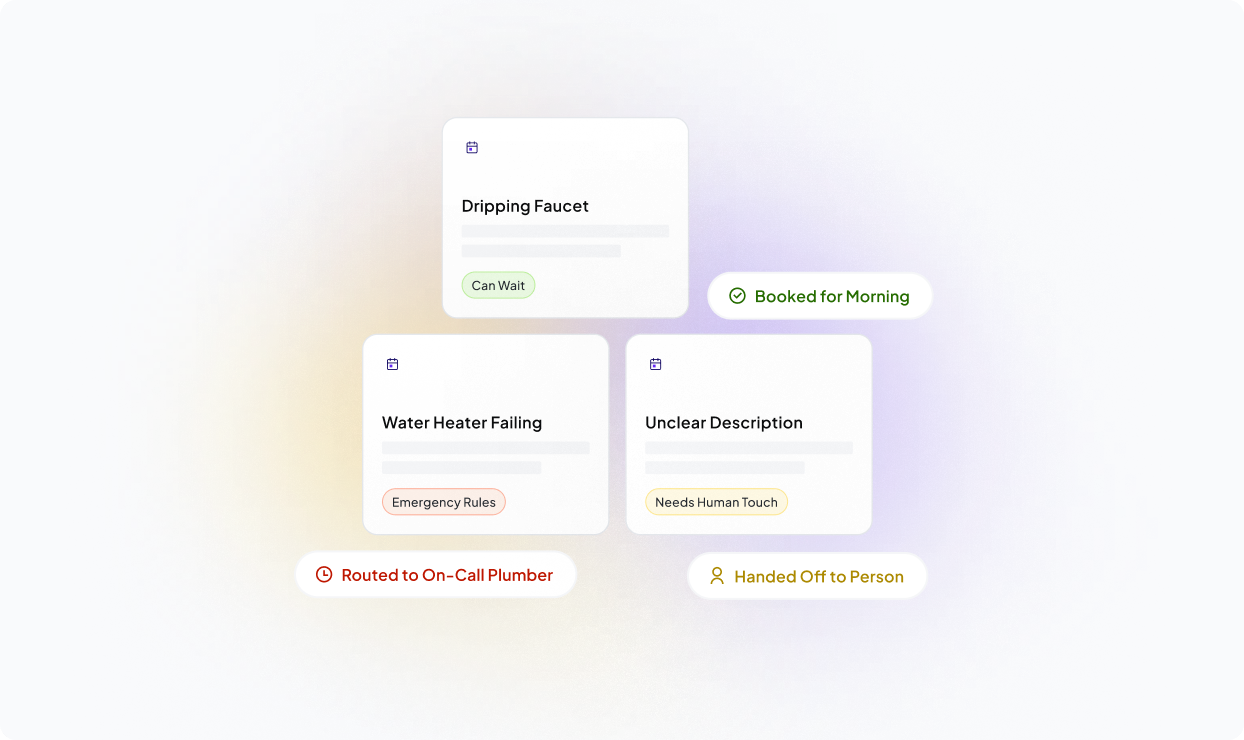
Iris does not freelance on what counts as an emergency. A midnight sewage backup wakes the on-call phone because you said so; a dripping faucet waits for a morning slot because you said that too. Change the rules any time.
Iris books only into slots you open and routes urgent work to whoever is actually on call. It fills your calendar the way your best dispatcher would, without double-booking your only Saturday tech.
Iris connects at the calendar level and hands your existing tools clean, complete job records. Keep the software your shop already runs; Iris covers the phone in front of it.
Setup is closer to onboarding a new hire than installing software. What Iris needs from you is the rule that decides which calls cannot wait until morning. Every call, contact, and job detail it captures stays yours.

Built by dotfun.
Before Iris was a product, dotfun's Run Good crew were building these automations one shop at a time. On the growth side of dotfun, we preach the same sermon to every trades client: the cheapest lead you will ever get is the caller you already answered. Need something wired deeper, like custom routing logic inside your dispatch stack? Ask us about a custom AI Solutions build; the same team ships both.
One truck, three crews, or a
Plumbing-only? This page is your setup. Running HVAC or electrical crews too? Every other vertical sits one level up.
Home services
Running HVAC or electrical crews too? Start from the broader answering service for home services page; every other vertical sits one level up.
HVAC
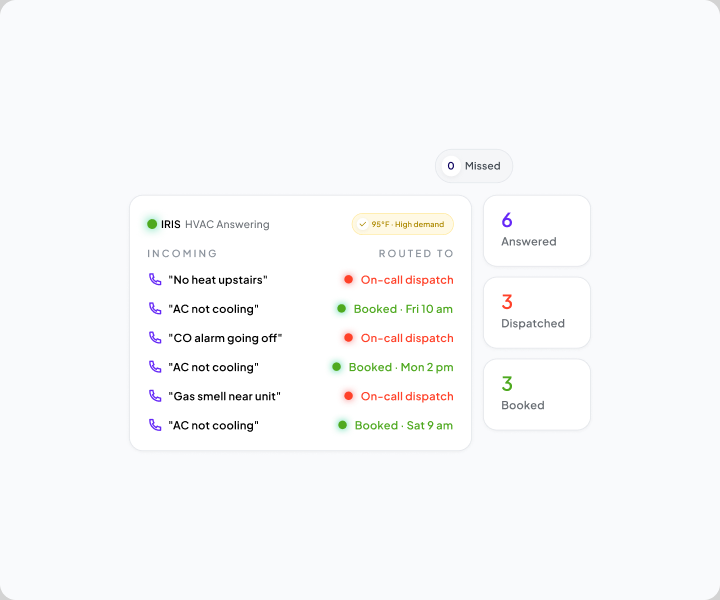
Surge capacity for the days the forecast fills your phone lines, with triage for no-heat, gas-smell, and CO calls.
Electricians
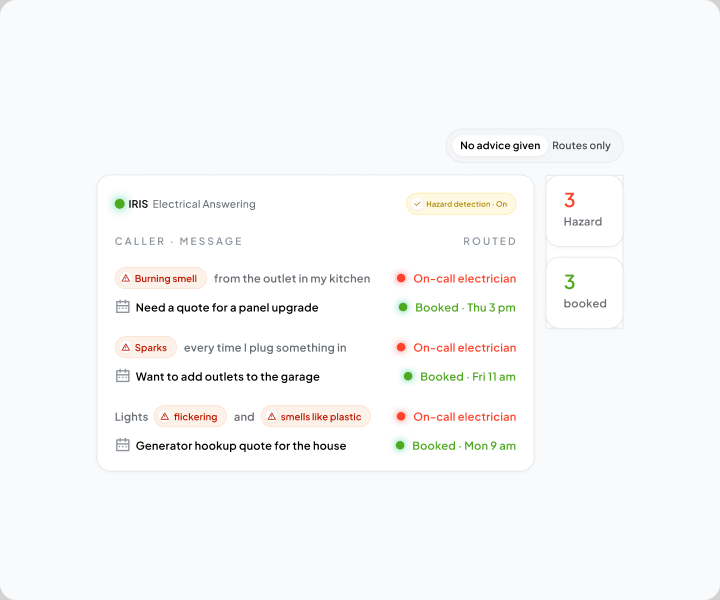
Hazard calls escalated to a licensed human, quotes and inspections booked on the calendar. Iris never gives electrical advice; it routes.
Simple Pricing That Pays For Itself
Most teams compare Iris to a $3k–$5k/month receptionist hire. We prefer a simpler benchmark: one saved job can cover the month.
Two in the morning, and other plumbing answering service questions
Traditional live answering typically lands plumbing shops between $200 and $500 a month, while AI services mostly run flat between $29 and $199. The vendor-reported ranges, per NextPhone, put the traditional model at a $50 to $200 monthly base plus $0.79 to $1.50 per minute, with busy months running over $800. Compare on a busy month, not the base fee, because per-minute billing charges most on long emergency calls.
By the rules you set. You define what qualifies as urgent and who is on call each night. When a caller reports active water, Iris captures the address and details, grades the urgency, and notifies your on-call plumber immediately with the full context. The caller gets a confirmation text, and the exchange is logged for the morning.
Yes, because the intake questions decide it. Active water where it should not be, such as sewage backing up, a tank flooding a garage, or water coming through a ceiling, follows the emergency path. A slow drain, a dripping faucet, or a quote request books a normal slot. Iris also asks whether the main is shut off, and anything ambiguous follows the cautious rule you chose.
A traditional plumbing answering service is a relay: an operator writes down what the caller says and passes it along. Water does not wait for a relay. While that message sits in a queue, the meter is still running in somebody's hallway. Iris acts on the call itself: it asks the dispatcher's questions, wakes your on-call plumber or books the slot, and texts the caller confirmation. The difference is a note about a flood versus a plumber already driving to one.
A plumbing virtual receptionist is usually a remote human who answers your line during office hours. Iris does that front-desk job with an AI receptionist instead: the same answering, intake, and booking work, at machine speed, on every call at once, around the clock. If you have been searching for an AI answering service for plumbers or an AI receptionist for plumbers, this is that category.
Iris books at the calendar level and hands your tools clean job records. If your shop lives inside a field-service platform such as ServiceTitan, Housecall Pro, or Jobber, the record arrives structured (caller, address, what failed, what was booked) so your dispatcher works from it instead of rebuilding it by phone. The platform you already pay for does not change.
Iris stops at the edge of the conversation. Everything inside it (answering, intake, grading urgency, notifying your on-call plumber, booking, follow-up) the product already does. Past that edge sits rotation logic across several crews, or automation living inside your dispatch platform. dotfun builds that as AI Solutions, on top of the record Iris already keeps.