
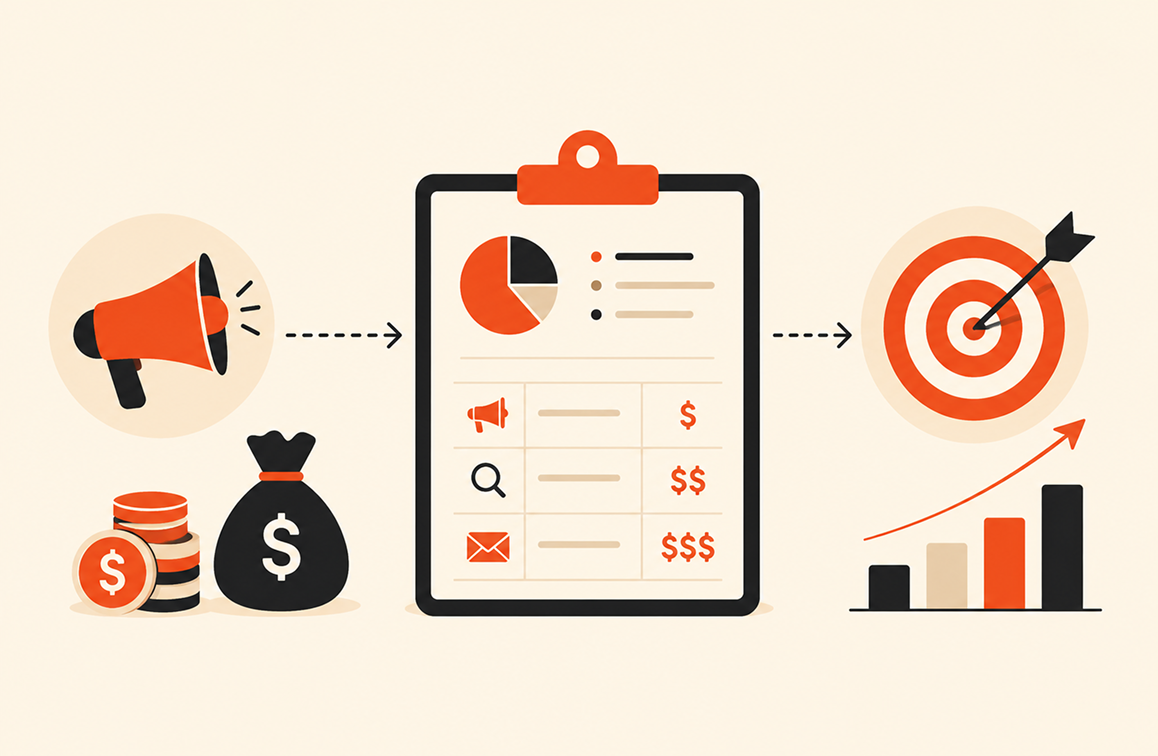

Most marketing budgets at B2B companies get set the wrong way. Someone asks the CEO for a number. The CEO looks at last year's spend, adjusts for how revenue feels right now, and hands a figure back. The marketing team builds a plan around that figure. And then everyone moves on without ever asking whether that number is actually connected to a growth outcome, or whether the allocation inside it makes any strategic sense at all.
The number usually ends up being both too small and split incorrectly. Not because the team is bad. Because the budget was never grounded in a growth motion in the first place.
Here is what the B2B marketing budget data actually says. Here is how allocation works at each stage of growth. And here is the sequence of decisions that most B2B teams get backwards.
The benchmark everyone searches for
There is a number people want. According to The CMO Survey, conducted in partnership with Duke University and Deloitte, the average company spends approximately 11.4% of its total budget on marketing. B2B companies specifically allocate between 8% and 11% of revenue, narrower than B2C which runs 9% to 12%.
Industry cuts this further. Tech software and platform companies average 9.16% of revenue on marketing. Professional services companies run closer to 11%. Companies that sell services consistently outspend companies that sell products. This makes sense: a service requires continuous trust-building in a way a well-understood product does not.
If you want a more B2B-specific benchmark, Transmission Agency's 2024 analysis puts the average B2B allocation at 7.7% of revenue, down from 9.1% in 2023. That compression reflects the economic environment most B2B companies operated in during the past two years: tighter scrutiny on marketing spend, more demand for attribution, less appetite for expensive experiments that take twelve months to show returns.
The honest context for all of these benchmarks: they describe what average companies do. If your goal is to grow faster than average, average spend is not your target.
Stage determines everything
The benchmarks assume you are an average company at an average stage. You are probably not.
At Seed and early Series A, you are still finding your channels. You do not know yet which marketing channels will drive your primary demand generation engine: LinkedIn Ads, Google Search, outbound, or content. Discovery costs money. So early-stage B2B companies typically need to invest more, not less, often in the range of 12% to 18% of revenue. You are building from scratch. The cost of not finding your channel early is far higher than the cost of the discovery itself.
At Series A to B, the question shifts. You should have some channel proof by now. You know whether your content is generating pipeline or just traffic. Your B2B marketing budget at this stage should follow what the data is telling you: concentrate in what works, cut what does not, and keep a meaningful portion for channel testing. Most B2B teams at this stage are in the 8% to 12% of revenue range. But the allocation inside that number matters far more than the number itself.
Post-Series B is when efficiency becomes the primary driver. You are not discovering channels anymore. You are extracting as much pipeline as possible from a proven growth system. Budgets here often compress to 6% to 9% of revenue, with tighter scrutiny on every line item and a heavier investment in optimization over net-new acquisition.
Most of the growth-stage B2B SaaS teams I work with are at the Series A to B inflection. And most of them are underinvesting in content and SEO while overinvesting in paid media. The ROI data makes clear that is the wrong direction.
Where the ROI actually lives
Not all marketing channels produce the same return. First Page Sage tracked 46 B2B SaaS companies and measured three-year average ROI by channel:
- Thought Leadership SEO: 748%
- Webinars: 364%
- LinkedIn Organic: 229%
- Email Marketing: 201%
- LinkedIn Ads: 94%
- Trade Shows: 85%
- SEM / PPC: 46%
These are averages, not guarantees. But the pattern is consistent. Channels that compound (thought leadership SEO, email, LinkedIn organic) generate far higher long-term returns than channels that stop the moment you stop paying for them.
And yet most teams allocate the biggest budget line items to paid search and paid social. The channels with the weakest long-term ROI consistently get the largest share of spend, because they are the easiest to justify in a quarterly review. You can show clicks and leads in a slide deck. A well-ranked article that generates inbound pipeline for three years is harder to put in a chart, so it gets underfunded.
This is not an argument against paid channels. Paid search and LinkedIn Ads earn their place during discovery and when you need pipeline velocity fast. But they should not anchor your allocation when you have a growth motion that can sustain longer-horizon investments.
How to allocate your B2B marketing budget
Once you have the total budget set, the allocation question is where most teams leave money on the floor. Here is a working framework: roughly 50% of your total marketing spend goes to digital channels, with 40% to 50% of that digital slice dedicated to content creation and organic programs, and 30% to 40% going to paid channels. That leaves 10% to 20% for brand, events, and strategic experiments.
Inside that structure, the 70-20-10 rule holds up well in practice. Seventy percent of your budget funds proven, producing channels: the ones with clear pipeline attribution and consistent returns. Twenty percent goes to channels you are actively testing with intent to scale. Ten percent goes to genuine experiments. The danger is that "proven" never gets defined rigorously. Teams label spend as proven because it has been running for a year, not because it has demonstrated real pipeline attribution.
Before you lock in your annual budget, be honest about which line items have actual closed-revenue data behind them, and which ones have been running on faith. That is the difference between a real allocation and a historical pattern.
For a $500,000 B2B marketing budget, the mistake is spreading it across eight channels at $60,000 each. None of those channels gets enough fuel to show what it can do. The same budget concentrated in three well-chosen channels (content and SEO, one paid channel, and email) generates far more signal and far more pipeline. Concentration wins. Thin coverage everywhere is not a strategy. It is a way to get mediocre results everywhere. I have never seen a team solve a budget problem by spreading thinner.
The mistakes that cost growth-stage teams most
Spending on brand before you have pipeline is the most expensive mistake I see at this stage. Brand investment matters. But if you do not have a repeatable demand generation system (a way to generate qualified pipeline consistently from your ideal customer), you are building the roof before the foundation. You will get impressions. You will not get leads. That gap compounds.
The second mistake is running paid ads without attribution infrastructure in place. Before you scale any paid channel, you need to know which campaigns are producing qualified pipeline: not just traffic, not just form fills, but opportunities that close. The tracking setup comes before the ad budget. Every time.
The third mistake is treating the budget as a fixed document. A budget set in November that is never adjusted until the following November will be misaligned by March. The market moves. Channels shift. What drove pipeline in Q1 may not be working in Q3. I have seen teams hold their allocation fixed for twelve months while a previously strong channel decayed, discovering the problem only during year-end review. Review allocation quarterly. Teams that do get more out of the same spend.
The fourth mistake is funding headcount before funding infrastructure. Many teams find a fractional marketing team outperforms a single in-house hire at this stage precisely because the infrastructure question gets answered first. A new marketing hire is expensive: salary, benefits, ramp time. If your team does not have working attribution, a CRM that sales actually uses, and a content system that produces consistently, adding headcount does not fix the problem. It adds payroll to a system that is already underperforming.
What to protect when the budget gets cut
At some point, every B2B marketing budget gets squeezed. Revenue misses a target. The board asks for tighter cost control. The question is not whether this happens. It is what you cut when it does.
Proportional cuts across the board make no sense. That approach penalizes your best channels and your worst channels equally. Start with what has the longest feedback loops and the weakest attribution. Trade shows are usually first. Physical events are expensive, attribution is murky, and teams claim pipeline impact rather than demonstrate it. Generic brand campaigns without clear pipeline data go next. Those cuts are safe.
What you protect: content and SEO programs, email nurture sequences, and any paid channel with real, attributed pipeline data. These are the channels that will still be generating returns twelve months from now. Cut the noise. Protect the compounding.
Your budget is not just a cost. It is a statement about what growth motion you actually believe in.
Frequently asked questions
What percentage of revenue should go to marketing for a B2B company?
The data points to 7% to 11% of revenue for most B2B companies, with tech software companies averaging 9.16% of revenue according to CMO Survey data from Duke University and Deloitte. Early-stage companies often need to invest more, often 12% to 18%, because they are still discovering channels and the cost of not finding a working growth motion early is real. More established companies with proven growth systems can often sustain results in the 6% to 8% range as they shift focus to efficiency. The right number depends on your growth stage, your channel maturity, and what you can actually measure.
How should a Series A company allocate its B2B marketing budget?
A Series A B2B company should weight heavily toward demand generation, not brand. In our experience, the allocation that produces results is roughly 50% to 60% on proven or actively tested demand generation channels (content, SEO, LinkedIn organic, and targeted paid), with 20% to 30% on sales enablement and nurture infrastructure, and 10% to 20% on channel experimentation. If you are still deciding whether to build in-house or bring in outside help, that question is worth answering before you set the budget. The non-negotiable before scaling paid channels is attribution: you need to know which campaigns are producing qualified pipeline that closes, not just leads that enter the CRM.
What is the biggest budget mistake B2B teams make?
Funding channels before the infrastructure to measure them. Paid search is not a bad channel. Teams allocate budget to it before they have working closed-loop attribution, a clean CRM integration with sales, and a clear definition of what a qualified opportunity looks like. Without those three things in place, you are spending money to generate data you cannot interpret. The attribution infrastructure always comes first.
Should budget follow strategy, or does budget set strategy?
Strategy comes first. Your budget should be a translation of your growth motion into dollars, not the other way around. If your strategy says you need 50 qualified inbound opportunities per quarter, the budget question is: what does it cost to build and operate the inbound system that produces that? Working backward from the outcome to the required investment is the correct direction. Working forward from a number that felt safe to whatever that number can buy is how you end up with a budget that does not match your objectives.
.png)
.png)
.png)
